Coffee with OKRs #48 · 12 min read
If it doesn't tell you what not to do, it isn't a strategy
When we ask a company about its strategy, we usually get one of three things: the name of a framework, two hundred slides commissioned from outside, or a sentence about who the company wants to be in a few years. Each of them has a purpose. None of them narrows a single decision, and narrowing is exactly what a strategy is for.
Let's start the other way round, with what strategy is not, because these are the things we most often get as an answer. Balanced Scorecard, SWOT, Evidence-Based Management, a review of growing pains: these are lenses. Each lets you look at the organisation from a particular angle and each ends in a list. A list of gaps in the management system, a list of improvements, a list of initiatives. We once came across an organisation that answered the question about its strategy by saying it had a Balanced Scorecard, as if one were the same as the other. But a list of improvements is not an idea of where we are going.
The second thing is two hundred slides. In larger companies, management brings to the meeting a strategy commissioned from an outside adviser, and it looks impressive: where we stand in the market, who the competition is, what the barriers to entry are, why we are not winning today. All of it is true and all of it is needed. It simply isn't a strategy. It is strategic analysis, the input you need before you can write one. Two hundred slides of information about reality contain not a single decision.
The third is a vision presented as a strategy. We want to grow several times over, we want to be the best at what we do. Next to it there is usually a set of metrics labelled strategic: this much revenue, this much cost, this retention, this market share. The problem with that set is simple and easy to check in your own company. It doesn't help you make a single decision one way or the other. Once you have read it, you can still do anything.
On top of that, the word itself has been inflated. Marketing strategy, sales strategy, AI rollout strategy, strategic initiative. What these usually have in common with company strategy is that someone wanted to signal that the thing matters. And one more point, against our own sign above the door: OKRs are not a strategy either. They are a tool for iterating it and the result of a decision made earlier. On their own they don't tell you what the company should focus on, or where to get the data for that decision.
Problem, policies, goals. In that order
Strategy starts with naming the problem or challenge the company is actually facing. It sounds trivial and it is the hardest of the three steps, because it means looking at the organisation and the market without anaesthetic. A financial goal lets you skip that step: you can say you want to grow several times over without touching a single real problem. You can't ask what challenge the company faces today without taking that look. That is why the question is the beginning of a strategy, and the financial goal is often a way to slide past the problem.
Then come the policies, the guiding principles that say how we intend to work on the problem. This is the first level of narrowing and the most underrated piece of the puzzle. Simply saying roughly how we will work rules out some options from everything available, and ruling things out is the actual work here. A company that hasn't written this down can still do anything after the workshop, it just feels better about it.
Last come the strategic goals, the answer to the question of how we will know we are getting closer to solving the problem. This is where measurability and a time horizon come in, today usually one to three years. Only from these three elements together do the choices follow that companies try to start with: which markets we compete in, with which products and against whom.
There is one test of usefulness and it can be uncomfortable: does what you have let you say what you will not do? Picture four lists of initiatives, one from each of the four areas of the Balanced Scorecard, each sensible, each from a different bucket. Without a point of reference we aren't comparing apples with apples, we are comparing apples with bananas. You then can't say that marketing matters more than sales right now, because that decision is made one level above the areas it concerns.
Takeaways
Six things that separate a strategy from a document about strategy
- 01
A lens is not a strategy
Balanced Scorecard, SWOT, Evidence-Based Management and a review of growing pains show the organisation from one angle and end in a list of improvements. A list of improvements doesn't say where we are going.
- 02
Two hundred slides are input
Strategic analysis describes the market, the competition, the barriers to entry and the reasons we are not winning today. It is information you need for a decision, not the decision.
- 03
Three elements, in this order
A named problem or challenge, policies that say how we intend to work on it, and strategic goals with a horizon of one to three years. Missing any one of them breaks the whole structure.
- 04
Policies are the first narrowing
Just naming roughly how we work on the problem rules out some options. Without that narrowing you can still do anything, which means nothing has been chosen.
- 05
The test is: what we don't do
If initiatives come from different parts of the company, you can't rank them without a strategy. You end up comparing apples with bananas and choosing by persuasiveness, not by weight.
- 06
Strategy is a communication tool
The board sees the forest, the teams see the trees and what needs doing this week. A strategy should let people make good decisions on their own, not wait for a ruling from above.
From the episode · in Polish
An hour on what companies bring instead of a strategy
In this episode we first go through the things companies give us when we ask about their strategy: a framework, two hundred pages of analysis, a vision, a set of metrics. Then we break strategy down into three elements and show how to check whether they help you choose anything. The part with that breakdown starts roughly a third of the way into the conversation, and the second half covers the strategy workshop and why writing a strategy is a creative process, not an analytical one. from 00:18:11
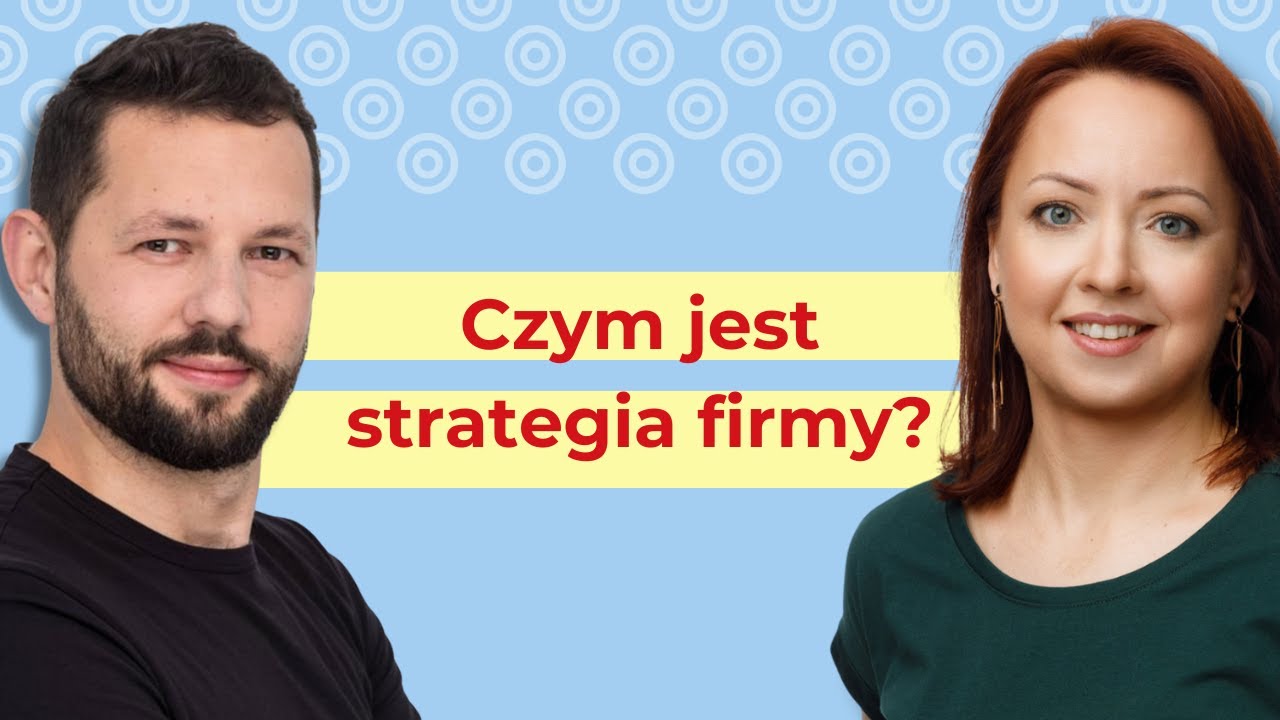 The recording is being edited. Leave your address and you'll get the link when it's ready.
How to check whether what you have is a strategy
Take the document your company calls its strategy and look for three things in it: a named problem, policies, and strategic goals with a time horizon. If there is only a number and a direction, it is a wish. If there is a problem and policies but no measurability, you can't check whether the idea works at all. If there are only goals, it usually means someone started from the end and skipped the hardest part.
The second way is quicker. Try to fill in the OnePager with everything you know about the organisation. If it fits, you probably have things in order and need nothing more, whatever you call it. Most often the trouble starts in the top part: it turns out there is too much material, or that the company has a list of goals and a list of initiatives that can't be pulled into one coherent whole. The third way is to ask leaders and teams whether they can make any decision based on the document. That question is merciless, because it goes to why a strategy exists in the first place. Not so that the board knows where it is going, because the board usually knows, more or less. So that people in the company can choose on their own instead of asking one level up every time. If leaders are still waiting for a ruling after reading it, the document may be very thorough and still not do the one thing it is for.
There is also a trap you walk into with the best intentions. A company sees its biggest constraint, usually marketing or sales, and goes after it because that is where it hurts most. It is relatively easy to say what isn't working. It is much harder to say what solving that problem will give us: whether we will get ahead of the competition, whether we will get closer to anything we care about. Without strategic goals there is nothing to compare it with, and the decision usually involves a lot of money and long months of work.
And one last thing, because without it the rest falls apart: a strategy is not written for the sake of being written. It is a set of living decisions that we test during the year. At an annual review with one of our clients, it turned out that the policies and strategic goals written a year earlier still held, apart from one change in the market, and the conclusions from the following quarters made it possible to update the policy and goals deliberately instead of rewriting everything from scratch. The opposite symptom is easy to spot too. If goals start to rule each other out while you are working on them, most likely nobody looked at the strategy when they were written.
Where strategies come from and who actually chooses the direction
It is worth knowing when companies take up strategy at all, because it explains why it so often ends in a document rather than a decision. Hardly anyone says consciously that the time has come to write a strategy. There are usually two ways in. The first: the company grows, departments multiply, and suddenly they need to be told something that keeps them moving in the same direction. The board feels that everything is obvious, while the teams do something else, because they see their week, not the market. The second way in: profitability drops, something has stopped working as it used to, and the board starts looking for a way out of the hole. In both cases the pressure is for a quick result, and that is exactly the moment when it is easiest to mistake a list of initiatives for a direction.
Once a company knows it wants to put a strategy together, the same idea usually comes up: let's run strategy workshops. Invite the board, the directors, the leaders, middle managers, product owners, thirty people in all. It looks great, because in one go we show people we are listening and we choose a direction. But a workshop like that mixes two different needs: engaging the organisation and deciding on the direction. You can't meet the first until the second is done, because you can't engage people in a direction the board itself hasn't chosen yet. A workshop like that either takes a very long time, or ends in generalities, or ends in nothing.
The conclusion is not: don't ask anyone. We gather information widely, including from the bottom of the organisation, because the board of a large company doesn't have full knowledge of how it works day to day. But the decision itself is made by the board, and not for reasons of hierarchy. Only that level sits above the individual areas, so only there can anyone say that this year marketing matters more than sales. What works best is separating the two in time: we gather information earlier and widely, and at the workshop itself we make decisions based on it.
In this episode we also say something that is hard to sell. Creating a strategy is not an analytical process. If it were, a scored ranking and a survey about constraints would be enough, and the decision would fall out of a spreadsheet. In practice, once the input data is gathered, there is a lot of chaos while you connect the dots, and the idea comes sometimes during a workshop, sometimes between workshops, and sometimes on an evening walk that opens up a completely new way of looking at the market. If the process were analytical, a good prompt to a language model would do. We would get decent input material, only exactly the same as the competition's, so nobody would stand out at all.
I write about this carefully, because we get lost in these words ourselves. In this episode we spend a good while arguing with a viewer about whether an idea is a strategy, and it ends with the conclusion that the dispute was about naming: an idea on its own is not a strategy, but an idea built around a problem, policies and strategic goals is. This is our perspective from more than twenty implementations in companies of different sizes and sectors, not a textbook definition. In six months it may look different, because that is what working with something you can't settle once and for all looks like. The difference between a document and a strategy stays the same: a document can be written and put away, while a strategy only shows in what the company deliberately does not do.
We talked about it in these episodes too
 Coffee with OKRsCompany vision and mission: how to build, test and use them
Steps back before the problem and the policies: it shows where a long-range direction comes from and says plainly that not every company needs a mission.
 Coffee with OKRs #53ESG in company strategy. Talking about the basics
Shows what happens to strategy when a second dimension of assessing the company is added, its impact, and why you begin with a double materiality analysis, not a report.
 Coffee with OKRsData strategy & company strategy. Friends or foes? Coffee with OKRs with Dora Boussias
A conversation in English about how a data strategy also starts from a business problem, not from a platform, and how its hard part is a shared language between departments, not the tools.
 Coffee with OKRs #37Marketing strategy and company strategy. Coffee with Jacek Kłosiński
Separates the organisation's strategy from its marketing strategy and adds the subversive claim that the word strategy itself can get in the way of a conversation with a client.
 Coffee with OKRs #49Operational excellence?
Takes up the other side of the same problem: improving operations can be a comfortable escape from strategic thinking, and companies measure too much, not too little.
Author


Lena Zhukova
founder; strategy workshops, quarterly sessions
Founder of OKR Poland. For twenty years she has worked with boards of companies from 30 to a few thousand people; she wrote dozens of strategies with them and helped implement them in more than 40 organisations.
Next texts by e-mail
The OKR Poland newsletter
We write when we have something to say. To start: eight hours of recording on preparing a company for strategy workshops, plus the OnePager.