Coffee with OKRs · 6 min read
Pretend you already have all the data in the world. If you don't know what to do with it, no tool will fix that
Organisations actually use around 20 per cent of the data they have. The rest they move around and process just in case, so for them data is an operating cost, not an advantage. It comes from one reversal of order: first we buy a platform, because that is the name of what the market is talking about, and then we look for a use for it.
From the episode
A conversation in English about what a data strategy is not
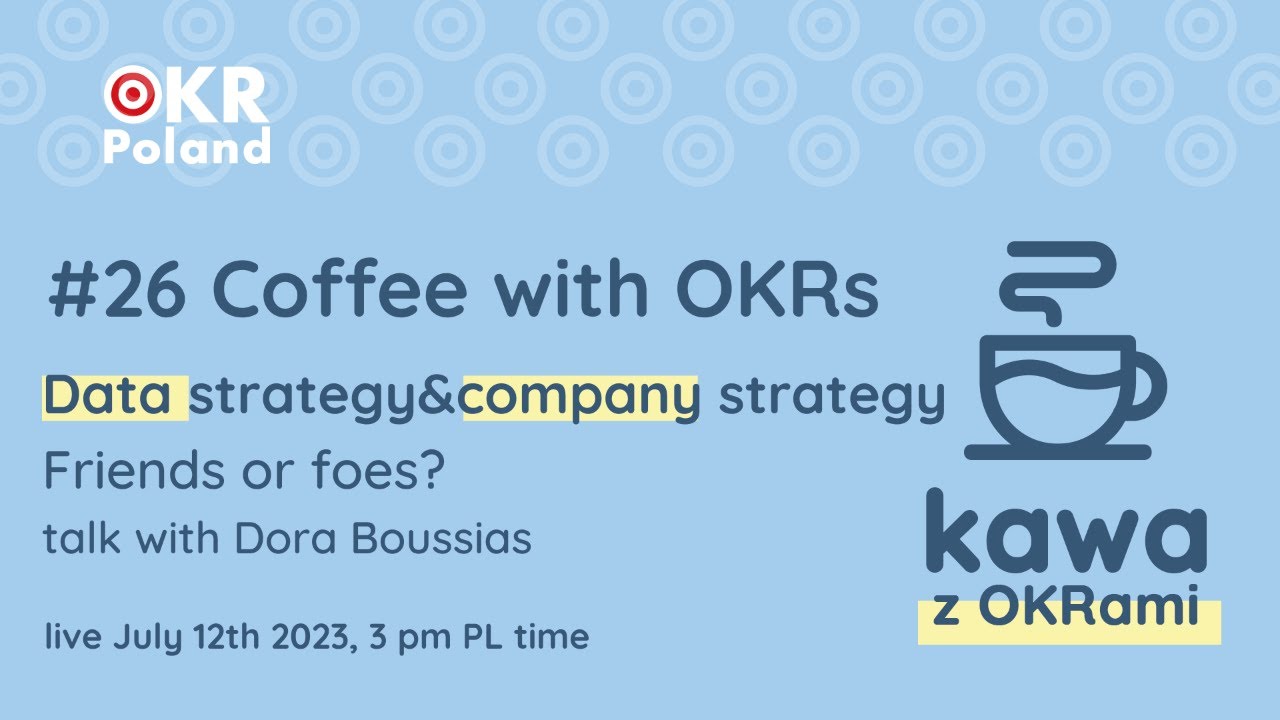
The guest on this episode is Dora Boussias, a leader in data transformation and enterprise architecture, and the whole conversation is in English. At around the fifteenth minute we separate technology strategy from data strategy, and data architecture from information architecture; at the eighteenth we go through the pillars and the maturity curve; and at the twenty-seventh comes the counter-question this text starts with. The second half has a part about a shared language between departments and about why implementing a data strategy is a transformation programme, not a tooling project. from 00:27:14
 The recording is being edited. Leave your address and you'll get the link when it's ready.
Requests arrive phrased as a solution, not as a problem. Build us a data lake. Set up a machine learning engine. In this episode there is one counter-question for this that is worth stealing: pretend you already have it in place, with everything that exists in it, and tell me what business problem you are solving right now. Without that answer you are looking for a needle in a haystack you piled up yourself. A technology strategy is not a data strategy, and a tool has never been the answer to a strategic question, even though that is where companies most often start. The same mistake comes back every few years under a new name, so it is easy to recognise: the request names a class of system, not a sentence about what the company can't decide today.
The hard part of this work isn't configuring the tools, it is that every department defines the same concepts its own way. The episode gives two examples that make this vivid. A bank in which one system kept accounts at branch level and another at the level of the whole bank, so the data couldn't be reconciled, even though reporting had to be done at the lower level. And an organisation in which two sales divisions assign the same product to a different business unit and a different legal entity, so the sales figures simply can't be added up. Hence a distinction that comes back several times in the conversation: information architecture is not data architecture. Before you describe the tables in a system, you have to know what a client means in this company and what relationships it has in the business context. I write this with some embarrassment, because we ourselves use the word strategy as if everyone understood it the same way, and this episode shows that the assumption doesn't hold even inside a single organisation. There is no standard definition for data strategy, for governance or for a catalogue, so the first step is to agree within your own company what these words mean for you.
The rest is about execution and will sound familiar to anyone who has worked with objectives. A strategy without a focused execution plan is a nice thing on a slide, and carrying out tasks without a plan will only take you so far, so the two have to feed each other. Instead of boiling the ocean, doing twenty per cent of a hundred things at once, it is better to choose five and deliver them in full, because only a finished thing delivers value. Nor is there a single indicator that tells you how you are doing: each pillar, from data quality to privacy, is measured separately and in proportion to where you are on a five-stage maturity curve. And the most important decision is organisational. Data strategy and business strategy are not two parallel tracks with points of contact, but one conversation, so the person responsible for data should sit among the stakeholders of the company's strategy, not receive its results to carry out.
Takeaways
Four things to take from this conversation
- 01
The problem before the platform
A request that names a class of system is already an answer to a question nobody asked. First name the business problem, then choose the tool, never the other way round.
- 02
The hard part is agreeing the language
A shared understanding of what client, sales and division mean is the real substance of this work. Technology is the easier part, although it looks like the harder one.
- 03
Five things in full instead of a hundred in pieces
Twenty per cent of a hundred initiatives delivers no value, because value only appears in a finished thing. A hundred ideas can stay on the list if you do them one after another.
- 04
The data person at the strategy table
Data isn't a track running parallel to the business with a few points of contact. If the person responsible for it receives ready-made decisions to carry out, the conversation has already gone off course.
The whole topic in one place
What is company strategy?
This episode shows strategy through one lens, and a lens needs a frame. The frame is in the text on company strategy: what exactly makes one up, why it starts from a named problem, just as it does here, and how to tell that a document called a strategy doesn't decide anything. That is also where you will find the other episodes in which we look at the same thing from other angles.
Author


Lena Zhukova
founder; strategy workshops, quarterly sessions
Founder of OKR Poland. For twenty years she has worked with boards of companies from 30 to a few thousand people; she wrote dozens of strategies with them and helped implement them in more than 40 organisations.
Next texts by e-mail
The OKR Poland newsletter
We write when we have something to say. To start: eight hours of recording on preparing a company for strategy workshops, plus the OnePager.