Coffee with OKRs #56 · 12 min read
OKRs don't clash with the methods you already have. A second list of priorities does
For five years the same question has kept coming back to us at meetings and meetups: how do you reconcile OKRs with project management so that one doesn't get in the way of the other. After more than a dozen companies in which we tested different approaches, my answer is a little disappointing. There is nothing to reconcile. The conflict people report doesn't come from the methods being incompatible.
I'll start with a sentence that rarely gets the room excited. Working on an OKR is project work. It is limited in time, it has a defined result, a defined team and defined roles. That is the definition of a project, one to one, just under a different name. Project management has been around for seventy years, and OKRs have not invented any new mechanics at that level.
This has a consequence you can see in every implementation. If project management doesn't work in a company, meaning there are no standards for running projects, no project charters and no described responsibilities, then implementing OKRs gets hard. Not because OKRs are complicated. Because they need exactly the same competence the company lacks. A new framework won't build it for anyone.
The sense of conflict comes from something else, and it is worth naming plainly. Two lists appear in the company: OKRs in one, projects in the other. On top of that, two ways of working and two roles, and nobody can point to the difference between them. People then don't ask about the method, they ask what actually separates these two worlds and why they should work one way one day and another way the next. This isn't a dispute about a tool. It is the result of putting side by side two things that answer different questions.
The OKR framework doesn't help settle this, because it says nothing about it. It tells you how to write objectives. It doesn't tell you where to get them from, and it says not a word about what to do with the projects the company already has. So an implementation always goes beyond the framework itself and comes down to decisions nobody will make for the company. Ninety per cent of the organisations we work with are medium-sized businesses of up to a few hundred people. A company like that has no separate reserve of people to look after the objectives.
One list of priorities, because there is one pool of people
The worst version of an implementation looks like this: the company gets a strategy and objectives, and is supposed to run its projects its own way. You then end up with two parallel management systems in one organisation. People don't know which meeting is for what, which competence to develop, or what to do with the existing portfolio of initiatives. This is not a theoretical problem. It is the working week of specific people, and it has to be divided up somehow.
The day before we recorded this episode, a client sent us a question that shows it best. An employee is responsible for an objective and at the same time runs another project. Which is more important, and is it even the same role. In terms of competence it is one and the same role: in both cases the person is responsible for a result and leads a group around it. The difference comes down to how much of their time goes here and how much there, and that is a decision to make during joint planning. Left to the person alone, it turns into their private dilemma, settled again from scratch every week.
What works for us comes down to one consistent way of managing and one list of priorities for a given period. Let's say that is a year and a quarter. On that list, OKR objectives and ongoing projects sit together, because the company has one pool of resources. In no organisation does a magic group of people suddenly appear to take care of the objectives while still having time for everything they did before. Let me say this straight away, because it is where the most common misunderstanding lies: one system doesn't mean one tool, it means one way of working. OKRs can live in a different program from projects and nothing bad will happen, as long as you run both to the same standard. The temptation goes the other way, towards looking for the perfect tool that will handle strategy, objectives, projects, tasks and a chat as well. That is an escape from an organisational problem into shopping. A tool is the result of a decision, not the solution to it.
There is one more reason this list won't come together without annual and quarterly goals. Without them there is no point of reference for prioritising. What is left is a large set of important things and an arbitrary choice of what we work on right now. That is exactly the gap between strategy and operations we talk about when we draw the organisation as a triangle: at the top it is clear where the company is going, at the bottom it is clear who does what on Monday, and in the middle there is nothing that ties the one to the other.
Takeaways
Six things to settle before you add OKRs to what you already have
- 01
Working on an objective is project work
Limited time, a defined result, a team and roles. If project management doesn't work in the company, implementing OKRs will be hard, because it needs exactly the same competence.
- 02
One list of priorities per period
Objectives and ongoing projects sit together, because there is one pool of resources. No extra group of people will appear in the company to look after the objectives.
- 03
One standard is not one tool
OKRs and projects can live in two different programs, as long as they are run with the same way of working. Looking for one perfect tool stands in for solving the organisational problem.
- 04
First decide what you won't work on
The first effect of joint prioritisation is a list of things rejected, and only the second is the order of what remains. Without the first part, the second is a wish.
- 05
The framework is silent about what you already have
OKR doesn't say what to do with existing projects. An implementation means reviewing the whole portfolio and closing initiatives that don't push the company in the chosen direction.
- 06
A project where you know the road, an OKR where you have a hypothesis
A project works when we know the result and know how to get there. Breaking a three-year strategy down into a network of projects assumes we know the future.
From the episode · in Polish
What a company with more than a hundred projects on its list looks like
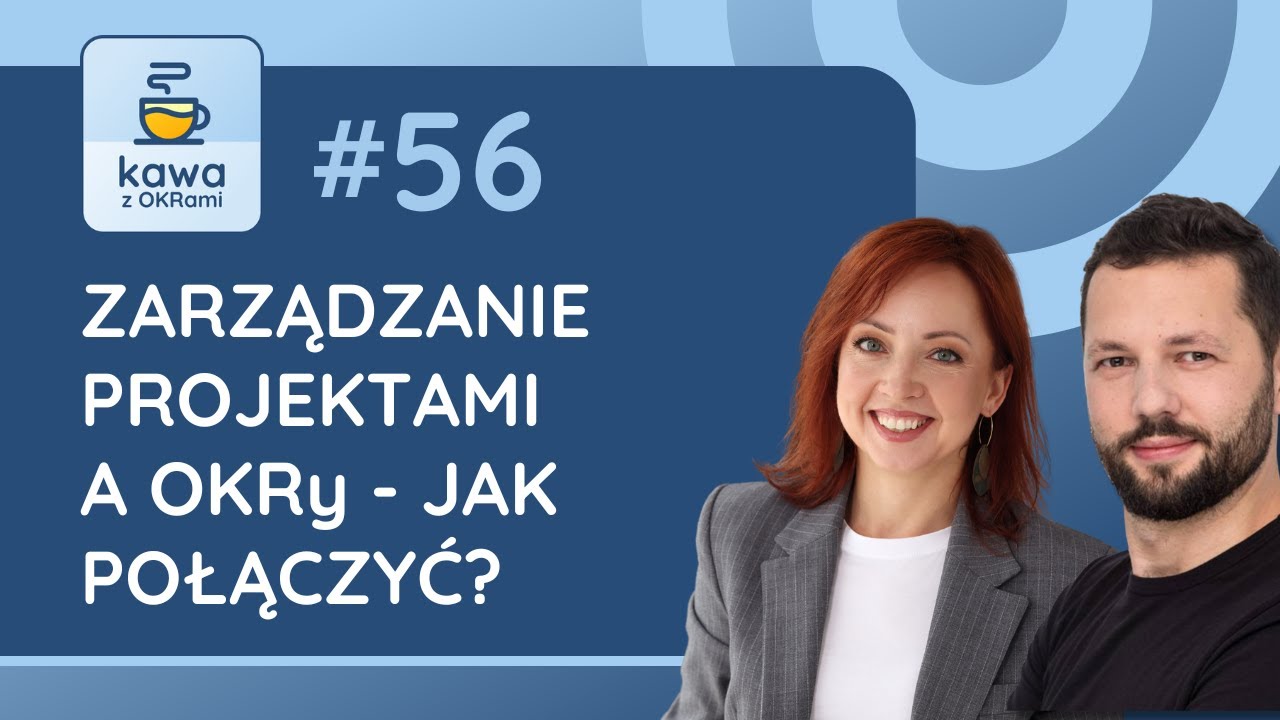
In this episode we take the whole mechanism apart: why working on an objective is project work, what agreeing one list of priorities together looks like, how an OKR owner differs from a project manager, and what the PMO does when there is meant to be one standard. The part about a company of around five hundred people, whose list ran to more than a hundred projects, some of which had to be closed, starts at around the thirty-ninth minute. from 00:39:15
 The recording is being edited. Leave your address and you'll get the link when it's ready.
What to do about it this quarter
Start with an audit of how the organisation works today, not with an implementation. The framework adapts to the existing way of working instead of standing next to it. If there is no standard for running projects, you have to introduce one, and that is the same work you would have to do for the objectives anyway. Better to know about it at the beginning than in the third month. And if you have a PMO, put both under it. Its role is sometimes understood as managing the project portfolio, but the second answer is closer to the truth: the PMO is responsible for introducing and upholding good standards in the organisation. If there is meant to be one standard, the teams working on objectives have no reason to stand outside it.
Then gather everything onto one list and set priorities together, with the board and representatives of the departments. Not for the sake of democracy. So that someone who took part in the meeting can later explain to their team why the decision was made. For each item, write down two things: why we are doing it now and not a quarter earlier or a quarter later, and by when the result has to be achieved and what follows from that date. A deadline for which nobody can say what will happen, or what will be missing, if we don't meet it, was set arbitrarily. One company does this in an order worth borrowing: first it sets and writes down its quarterly objectives, then it checks how much of the quarter's resources is left, and only into that remainder does it add things that are important but not urgent.
The hardest part is reviewing what is already going on. In one company of around five hundred people, the list ran to more than a hundred projects. After going through it against the chosen direction, some initiatives had to be closed: ones that worked directly against what the company had decided, and ones that had started for an unclear reason, with no known sponsor, while drawing on people and money. People can be attached to their projects, so the way you communicate weighs as much here as the decision itself. This is not a judgement of a project's value. It is a consequence of a direction the company stated earlier and clearly.
Finally, set a rhythm, but a shared one. If project managers meet on Mondays, the people responsible for objectives should be there too, and the other way round, so that blockers are visible in one place. At one client, in the weekly and monthly review, we looked at four quarterly objectives and two projects at once, because one of them was a construction project on which the company's next steps depended. Train both roles together, because the competence is the same. Require a measurable goal from ordinary projects too: not we will roll out a system, but what will change because of it. And the thing easiest to let slide: collect the conclusions from finished projects and objectives in one place and review them at least once a month for what they do to the assumptions behind the annual and strategic goals.
The same conversation comes back with every method
This text is about projects, because projects are where it most often starts. The question underneath is broader and concerns everything the company already has: the theory of constraints, Lean, Kanban, Scrum, value measurement, production planning. In this series we came back to it seven more times, each time with a different method, and in several conversations with a guest who knows it more deeply than we do. Each time the same thing came out: the method we were asking about answers a different question from OKRs, so there is nothing to choose between.
The shape of these conversations is surprisingly similar. In some we ask where in the system to apply force at all so that the result of the whole company moves. In others, what day-to-day work should look like for an objective to be delivered, or whether work on objectives is visible at all. In others still, how you know that the objective the board came up with is the right one. None of them ended with the conclusion that you have to pick one and put the other aside. They ended with working out which floor each one works on. Below is a map of where to look for what.
We didn't have this answer at the outset and we didn't take it from the framework, because the framework says nothing about it. We tested different approaches in more than a dozen companies before we started saying plainly that implementing objectives begins with an audit of how the company works today. The effect of that work is less spectacular than it sounds. The company doesn't suddenly have more people or more time. It has one list that someone can defend, and it knows what it isn't doing this quarter.
We talked about it in these episodes too
 Coffee with OKRsOKR vs Scrum. Together or apart?
Closest to this text, but one floor down, at the level of delivery: why starting from processes and tools, in the hope that the mindset will follow, is the common denominator of almost every text claiming that Scrum or OKRs don't work.
 Coffee with OKRsKanban and OKRs: can they work together? A conversation with Radek Orszewski
A conversation about what an OKR doesn't show: whether work on an objective is flowing at all, how to split the day-to-day and work towards objectives on one board, and why saying that daily work and OKRs are separate is a diagnosis of a badly written objective.
 Coffee with OKRsLean and OKRs. Do they fit together? A conversation with Rafał Szymański
On the layer of daily work: without it a company sets itself ever more ambitious goals and scales its own inefficiency, because it plans without regard to the real throughput of the process.
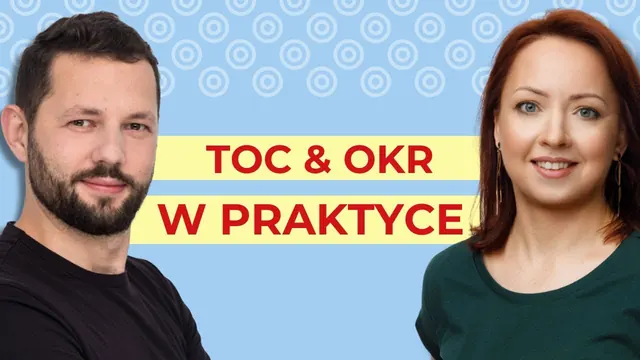 Coffee with OKRs #40Can TOC help with an OKR implementation? Coffee with Adam Myszak
The only conversation about WHERE to put an objective: the theory of constraints points to the place where leverage moves the result of the whole organisation, and it includes the uncomfortable line that the constraint usually turns out to be the board and its paradigms.
 Coffee with OKRsEvidence-Based Management (EBM) vs OKRs. A conversation with Magda Firlit
On the source of objectives rather than on execution: how you know that an objective the board came up with is the right one, and why objectives come from choosing a hypothesis, not from cutting a strategic goal into smaller pieces.
 Coffee with OKRsEvidence-Based Management (EBM) vs OKRs. Implementation. Second conversation with Magda Firlit
The implementation version of the same pair: what to do when a company has neither measurement nor objectives, when it has one of the two, and where each of these methods breaks when you implement it on its own.
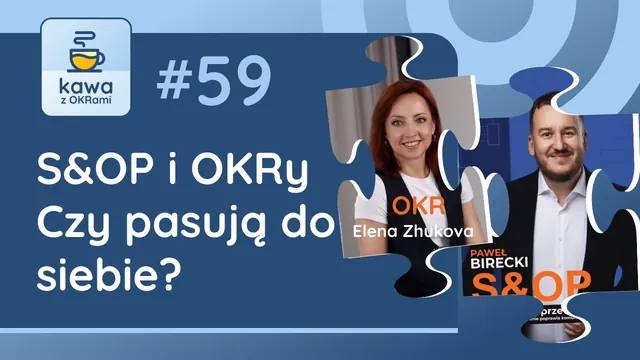 Coffee with OKRs #59Production planning and OKRs. A closer look at S&OP
The only conversation about planning in a manufacturing company: S&OP and OKR grew out of the same pain, and the only real dispute is about order, whether to sort out the day-to-day first or the future.
Author


Lena Zhukova
founder; strategy workshops, quarterly sessions
Founder of OKR Poland. For twenty years she has worked with boards of companies from 30 to a few thousand people; she wrote dozens of strategies with them and helped implement them in more than 40 organisations.
Next texts by e-mail
The OKR Poland newsletter
We write when we have something to say. To start: eight hours of recording on preparing a company for strategy workshops, plus the OnePager.