Coffee with OKRs · 13 min read
Five client meetings aren't a result. They're an idea that took the result's place
The objective read: by the end of the quarter we will widen the base of clients we help to implement OKRs. Under it, the key results: meet five clients, roll out a tool, build a landing page. All measurable, all easy to tick off. And after the quarter we know nothing except that the base didn't widen.
This isn't an example from someone else's company. It is our own objective, written out exactly as it stood back then. Every item has a number or a deadline, so it passes the measurability test with no trouble. On a Wednesday you can say how much of it is done. And yet these aren't results, just a list of ideas for how to achieve the result.
It costs one specific thing, and you only see it at the end. When we carry out a set of actions that nobody matched to an outcome, after the quarter all we can say is that we didn't get where we wanted to be. We don't know which of those activities failed, what we should have done more of and what was completely unproductive. The point of reference disappears, and with it everything the quarter could have taught us.
The second loss is less visible and more costly. An objective written as an activity merges with the only idea for achieving it. The landing page stops being one of the roads and becomes an end in itself, so when a few weeks in it is clear that this road doesn't lead where it was supposed to, you can't change it without announcing a failure. A result described as an outcome leaves several paths open: if one turns out to be wrong, we change the way, not the objective.
I'm not writing this as someone who has put the problem behind them. The tendency to jump from the objective straight to initiatives is alive in our company every quarter, and keeping it in check costs two or three days of negotiation in which we check each other. Over time it gets easier to catch, because the first stumble is visible after a week or two, when you have to show the value of a result and all you can offer is the percentage of work done.
Every department does the best thing for itself
Without a shared result, each team still has to decide somehow what matters most right now, so it decides locally. Marketing does the best thing for marketing, sales for sales, product for product. Nobody sabotages anything, everyone works flat out, only the sum of these decisions doesn't add up to the company's result.
The episode gives a simple example. The developers improve something on their side, the improvement is real and sensible, and its effect turns out to be a longer implementation for the client. The outcome is the opposite of what was intended and nobody made a mistake. What was missing was one number against which both sides could have checked their decision before making it.
It is worth saying straight away something that comes through more strongly in this episode than the distinction itself: thinking in initiatives isn't always a mistake. In a small company working in startup mode it works well. Contact is close, sharing goals goes smoothly, and decisions are made in a narrow circle that has the full picture. The risks described above simply don't have time to appear.
It stops working when the scale jumps. Our guest, a manager at a company that provides a tool for online meetings and events, talks about the growth that came with the pandemic: more clients, more events on the platform, and with that a bigger team. A model that worked flawlessly with forty or fifty people turned the management, after that jump, first into a bottleneck and then into a brake on business growth. With that many people there is no chance that everyone thinks in the same initiatives, since many paths lead to the same goal.
Takeaways
Six signs that tasks are hiding in your key results
- 01
A line that isn't satisfying in itself
Ask about every result whether it satisfies you. Holding five meetings doesn't, because you are waiting for something to happen after them. That means what you have in front of you is an initiative, which may or may not lead to the objective.
- 02
There are a lot of results
Count them. There are always more actions leading to an objective than metrics by which we will recognise success. A long list of results almost always means tasks were written into it.
- 03
Implementation status in per cent
A result written as progress from zero to a hundred per cent is the first red light. You are then measuring effort, how much you have done, not what came of it for the company.
- 04
No answer to where the number will come from
If at the start you can't say how you will measure the result you wrote down, the objective is badly defined. Without that check you will find out at the end of the quarter, when there is nothing left to fix.
- 05
An objective pulled up too high
The question why, asked one time too many, lifts the objective to a level of abstraction at which it no longer decides anything. Stop where the objective still says what we are doing this quarter.
- 06
Results tied to bonuses
Linking objectives to money pushes teams to set safe objectives and breeds fear of not delivering. The bonus system needs to rest on something else.
From the episode · in Polish
The same objective in a bad and a good version, shown live
In the episode we take our own quarterly objective and rewrite it twice, then go through the warning signs that show tasks are hiding in the results. The block with examples starts at around the fifteenth minute, the mechanism with the question about satisfaction comes in the second half of the conversation, and at the very end there is an answer to a question from the chat about what to do with an existing bonus system. from 00:15:17
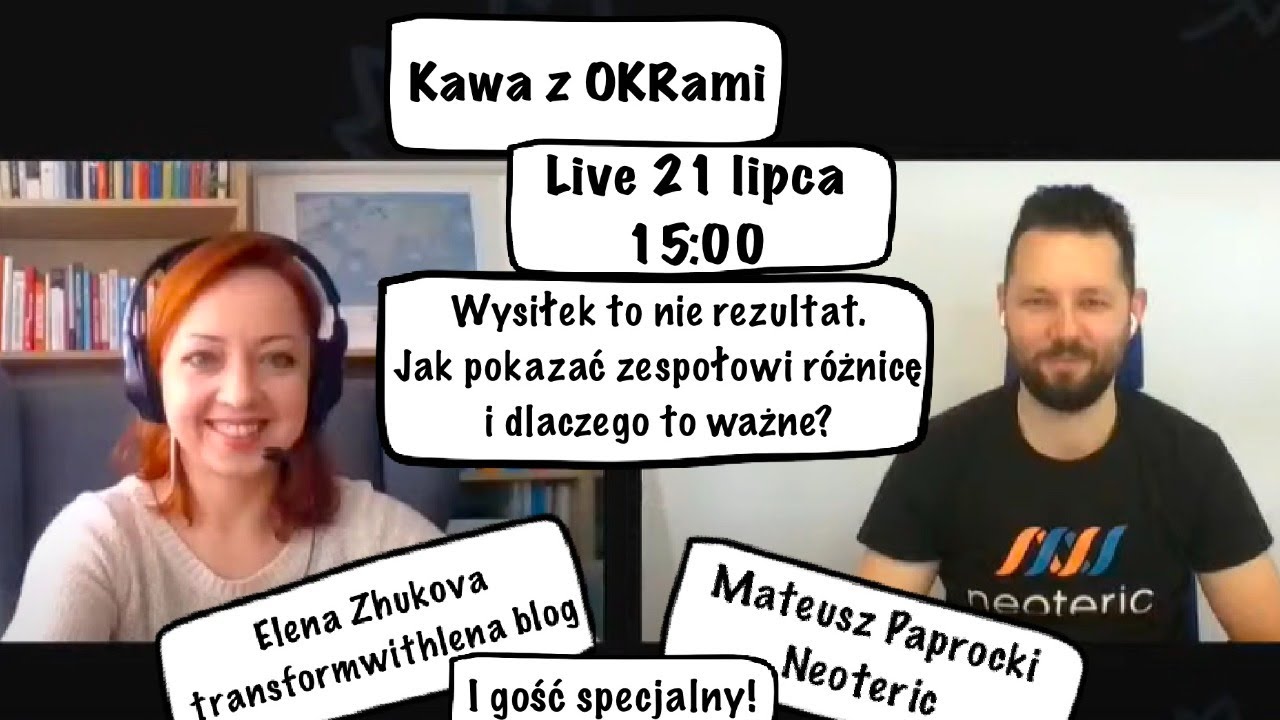 The recording is being edited. Leave your address and you'll get the link when it's ready.
The same objective, written a second time
The fix isn't to cross out the meetings and the landing page. They stay, they just move one floor down, as actions with which we try to achieve something. At the level of the result we write what should come out of them. A good test here is the question so what, asked of every result written down. If after that question you have to keep explaining what happens next, the result isn't a result yet.
The good versions in this episode talk about a change in client behaviour. Users use a given feature twenty per cent more often than before. The average number of events per user grows compared with the previous quarter. None of these sentences says what the team will do, each says what should change on the other side. That leaves the team the choice of the road and at the same time takes away the excuse, because ticking off all the planned tasks stops being proof of anything. Along the way, a line like that forces one check that is usually skipped: can we measure this at all. An objective is often inspirational by design and therefore vague, and only the result forces an answer to where we will get the number. If there is no answer in January, there won't be one in March either, except that by then nothing can be done about it.
There is one more switch, less textbook and in practice faster. Instead of starting from objectives, start from the metrics the organisation monitors anyway and considers important: the number of clients, churn, whatever the board looks at every month. The question then is which measurable effects matter to the company over a year, and only from that do we build the objectives. The order is the reverse of most training courses, but you start from numbers that already exist in the company, not from ones that have yet to be invented.
When even that isn't enough, two simple things help. First: imagine the objective has been achieved and work back to the results that would have had to occur along the way. Second: draw a chain of links in which a task leads to a result and a result to the objective. A whiteboard and a few arrows are enough. While drawing, you see fastest the tasks that can't be connected to anything, and those have to be either redefined or dropped. If the problem goes deeper, the technique of asking why again and again helps as well, because it leads to the actual problem instead of its symptom.
What changes in the team once you switch the way you write it
The most interesting change, however, isn't about the wording itself but about who creates it. The episode describes a seven-hour workshop at which the team first worked through the company strategy, the long-term vision and the market opportunities and threats, and only at the end wrote the objectives. The board then held them up against its own vision. A side effect nobody had planned was that it brought to light initiatives the board had no idea were going on in the company.
After that workshop one of the people said that before, they had felt they were working all the time without context, and the annual company meetings didn't give them that context. It only came from a day spent on the vision and long-term goals. This is the part you don't see in a spreadsheet of objectives: a result described as an outcome can be handed over to a team, while a list of tasks can't, because all the thinking stays with whoever wrote it out.
The further effects are down to earth and countable. The manager stops being a bottleneck, because the team doesn't wait for a free moment and a green light from them. Business lines that previously hardly talked to each other, and where nobody knew whether they were heading in the same direction, start negotiating objectives every quarter, until that conversation becomes a natural habit of the organisation. You then go to a team with a well-defined result and the question of what we can do to deliver it, instead of with a ready list of tasks to carry out.
There is one resistance in all this that we talk about openly in the episode, because it applies to us as much as to the teams we work with. Defining a result precisely is uncomfortable and time-consuming at the start, and under planning pressure it is easy to choose a quicker, vaguer wording just to get going. Then there is the opposite trap, perfectionism: polishing one sentence instead of choosing a version, testing it and improving it in the next period. A separate matter is the question why, which in a team with a tense atmosphere is sometimes used not to get to the meaning but as a way to block a topic; it is worth recognising, because it sounds identical. The practical way out of all this is one: start with a small scope, practise the mechanism on a piece of the company and only then widen it.
Two things to finish, because without them it doesn't take hold. Give the team the right to a weaker objective when you have no argument against it other than your own intuition; they will draw their own conclusions after the quarter or after a few more. And don't turn it into holding people to account, but into checking together whether we are going in the right direction, because everything else rests on exactly that. A company in which this has switched doesn't look spectacular. It looks like this: at the weekly meeting the question is what has changed for the client, not what percentage of the task is already done.
We talked about it in these episodes too
 Coffee with OKRsOutcome vs Output. A conversation with Agile Hunters
A conversation with Agile Hunters about how the system is to blame, not the people: an annual budget closed from the top forces a declaration of what will be built over the whole year, and the process has no built-in place for asking why.
 Coffee with OKRsWith Agile Hunters. Output vs Outcomes, part 2. Tools
A second conversation with Agile Hunters, this time about the artefacts of a product team: what this distinction changes in the roadmap and the sprint goal, together with a defence of a roadmap full of features, as long as there is value behind it.
 Coffee with OKRs #44Delegating with OKRs. How?
The practical use of this difference in delegation: why handing out tasks leaves all the thinking with the manager and turns them into a bottleneck, and how to choose the level of responsibility you hand over.
Author


Lena Zhukova
founder; strategy workshops, quarterly sessions
Founder of OKR Poland. For twenty years she has worked with boards of companies from 30 to a few thousand people; she wrote dozens of strategies with them and helped implement them in more than 40 organisations.
Next texts by e-mail
The OKR Poland newsletter
We write when we have something to say. To start: eight hours of recording on preparing a company for strategy workshops, plus the OnePager.