Coffee with OKRs · 6 min read
People don't choose tasks over outcomes. The annual budget chooses for them
Next year's budget is closed in the third or fourth quarter of the year before. To close it, someone has to declare up front what exactly the company will build over the next twelve months. And that is the moment when it is decided whether teams will work towards outcomes or through a list of features. Nobody calls the decision that at the time.
From the episode · in Polish
A conversation not about the definition, but about the cause
In this episode our guests are two agile practitioners, and for most of the conversation we are not looking for a definition but for the reason why a distinction everyone understands so rarely makes it into companies. The thread about the annual budget and the lack of room for experiments starts at around the fifteenth minute, the part about there being no time reserved in the process for asking why comes a few minutes later, and the second half is about changing the habit itself and about how many people have to want it. from 00:15:09
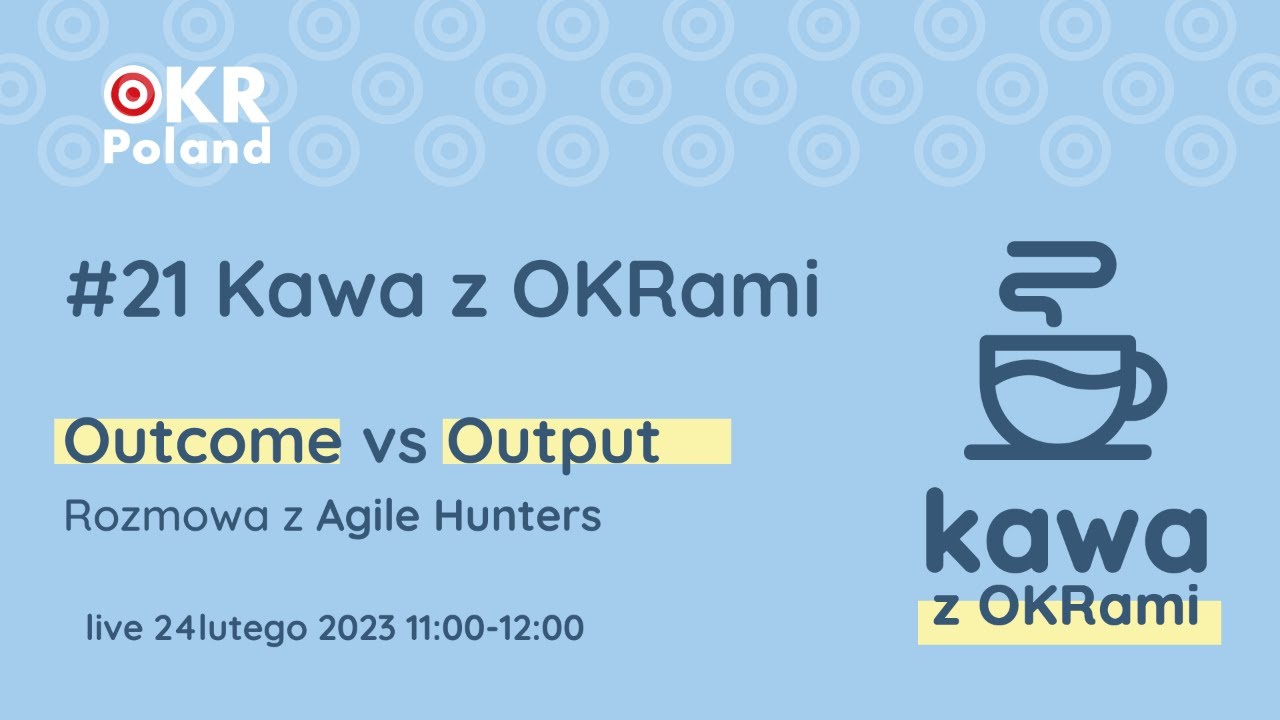 The recording is being edited. Leave your address and you'll get the link when it's ready.
Let's start with something that isn't a linguistic curiosity, though it looks like one. In Polish a single word covers both: how much work we have done and what we wanted to achieve. English has two words for it, output and outcome, we have one, and in this episode we treat that gap as a symptom, not a coincidence. If we have no name for the result we are heading towards, it is hard to expect a company to think in those terms. By default we think about ourselves and others in terms of efficiency: how much someone has done and how busy they are. We begin this conversation by admitting that we ourselves aren't sure we are doing it well, because slipping back into the old habit happens to us just as it does to the teams we work with.
The second part of the episode matters more, because it takes the blame off people and puts it on the system. An annual budget closed in the third and fourth quarter requires a declaration of what will be built over the whole year, and in itself shows what mode the company works in. Add to that the lack of reserved time for asking what the point is. If we count on someone finding that time one day, individual people will find it, and only until the backlog crushes them. You recognise a well-implemented process by the fact that doing the right things in it is easier than doing the wrong ones. The third reason is purely technical: a delivered feature is easy to confirm, because it exists and it works, while the impact it had is hard to measure and even harder to defend in front of someone who asks about progress.
The conversation also explains where the habit came from, and that explains more than complaining about work culture. In the factory and in early software, value was known in advance. The product was defined, and all you had to do was deliver it in the planned time and quantity. Today value first has to be established, and that is different work from delivering. In its place there is often a certainty that we know what the client needs, bordering on arrogance, because if we know best, user research is by definition unnecessary. The episode gives the simplest example possible: a feature for removing a product from the basket, built the way other systems do it, without asking anyone and without an experiment. Then the support tickets came in, asking how to remove an item from the basket. Not one, many.
Takeaways
Four things that turned out to matter more than the definition in this episode
- 01
Build the question into the process, not into an appeal
A well-implemented process is one in which it is harder for people to do the wrong things than the right ones. If the time for asking what the point is isn't reserved anywhere, individual people ask it, and only until the backlog crushes them.
- 02
The eleventh time, they ask it themselves
A change in thinking can't be taught in a single training or announced as a decision. What works is the same question asked a second, third and tenth time, because by the eleventh people ask it themselves without you.
- 03
Around eighty per cent of people have to want it
Below that threshold a transformation ends in failure, however well it was designed. That is why you first build awareness and willingness, and only then implement the change.
- 04
Behind the requested solution, look for the need
Those who commission the work and the users come with a ready solution, not with a problem. The episode gives the example of a request about a single button, after which the team, instead of building, went back to the question of the need and mapped out the options.
The whole topic in one place
Effort is not a result (Outcome vs Output). How to show the difference and why it matters
The distinction itself, together with how to rewrite a badly set objective and how to tell that tasks are hiding in the key results, we take apart in a separate text. It also has a map of the other episodes in which we came back to this thread. If you are looking for a place to start, start there.
Author


Lena Zhukova
founder; strategy workshops, quarterly sessions
Founder of OKR Poland. For twenty years she has worked with boards of companies from 30 to a few thousand people; she wrote dozens of strategies with them and helped implement them in more than 40 organisations.
Next texts by e-mail
The OKR Poland newsletter
We write when we have something to say. To start: eight hours of recording on preparing a company for strategy workshops, plus the OnePager.