Coffee with OKRs · 12 min read
An objective is an assumption. If you know how to deliver it, it's a project
The board comes to the workshop with one sentence: by the end of 2025 the largest universities in the States teach classes on our tool. It sounds like a finished objective. It falls apart at the first question about what the word use means in it: one professor running one seminar a month, or most lecturers running most of their classes there. Those are two different companies and two different years of work.
From the outside, writing goals looks like a linguistic exercise. Sit down, phrase a sentence, add some numbers to it. That is why in workshops someone regularly suggests quickly writing any objective at all and moving on. We turn that down straight away, because an objective is meant to carry out the strategy, and a sentence written without knowing what it follows from has nothing to carry out. It remains a correctly built sentence with a metric.
So before we write the first word of an objective, we set down in a structured form what we got from the company: which markets it plays in, who its client is, how it differs from others, what model it earns money in. And then we read it back to them. This is not a summary for the minutes, but a verifying paraphrase. Only when they hear their own company described in someone else's words do people realise that they meant something different. That moment is much cheaper now than in the third month of the quarter.
Even earlier, we ask for one sentence of mission and one sentence of vision. They usually live in the board's heads and are written down nowhere, so the first version tends to be uneven, and that is fine. At one client, two board members had completely different ideas of the same mission. They wrote down two sentences, adopted a partly shared version for the time being, and that didn't stop further work. Sometimes, though, you have to stop everything and work on it separately, because the next steps have nothing to hold on to.
The rest of this text is the road from a note like that to a quarterly objective with metrics whose numbers you know where to get. We show it on a made-up company, because it can't be told publicly on someone else's data, and without something concrete the process sounds like a set of generalities.
Strategy is not a list of strategic goals
The company in the example sells a web application for video conferencing on a subscription model. Mission: to connect people who want to learn and train, quickly and simply. Vision: to be the first choice in the video conferencing segment for education globally. Its advantage is simplicity and reliability, its clients small and medium-sized companies from Western Europe. There is also a little-used feature, a fully configurable quiz builder, which gets high ratings in the test group but is used by few clients, because it doesn't fit the existing target group. The whole new strategy hooks onto exactly this observation.
Where the company stands in numbers: 30 universities in the portfolio, only 3 of them from the USA, and the university segment is 10 per cent of monthly recurring revenue, around 9 thousand dollars. The board assumes that by the end of 2025 the company will reach 360 thousand dollars a month, 60 per cent of it coming from universities in the USA. Only a pair of numbers like that, today's state and the target state, turns ambition into a conversation.
Strategic goals on their own are worth little, though, until you know what problem the company is addressing and what its policy is, that is, its way of winning. Here the problem was: we can't compete head-on with the biggest players, who have incomparably larger budgets, and over time we will be marginalised. The policy: become the leader in the university segment thanks to a product dedicated to universities. Quizzes are a good point of attachment, but the company doesn't yet know whether they are the most important one, and that is exactly what it wants to test.
In the conversation we broke the board's sentence about using the solution down into three measurable strategic goals: the level of recurring revenue, the share of the American market in that revenue and the share of the largest universities. This is the laborious part of the work and there is no skipping it. Every unverifiable word left in a strategic goal comes back later as an argument about whether the goal was achieved.
Takeaways
Six things that decide the quality of an objective
- 01
Problem and policy first, then the objective
A list of strategic goals without a named problem and without a way of winning is worth little. An objective written on a foundation like that could just as well read completely differently, and nobody could say why not.
- 02
Break down unverifiable words before you start writing
They use our solution means both one professor with one seminar a month and most classes at a university. Spell out every word like that as measurable conditions together with the board.
- 03
An objective is an assumption, not a plan
If you know what to do and how, just do it: that is a project. An objective describes a hypothesis you want to test in a given period, and that is why it is allowed not to come off.
- 04
Key results should be relatively independent
If you tie the metrics together so that they balance each other, the failure of one topples them all and you don't know which of the remaining assumptions held up. An independent set gives you information even when the objective wasn't achieved.
- 05
Two exercises for a complete set of metrics
Imagine the last day of the period with exactly these results and check whether that is enough for you. Then do back tracking: does every element written into the objective show up in one of the metrics. Three to five metrics is a statistic from practice, not a rule.
- 06
The whole company writes goals first
The annual and quarterly objective is created at the level of the whole company, whatever its size. The question of departments, teams and roles comes next, not first.
From the episode · in Polish
The whole process of writing goals, step by step, on one example
This episode is a behind-the-scenes record of a workshop: from the note we get from the company, through putting the strategy in order and an annual objective with four key results, to a quarterly objective and a narrative for the organisation. The strongest part, on why key results shouldn't balance each other, starts at around the forty-fifth minute and is an answer to a viewer's question. from 00:45:28
 The recording is being edited. Leave your address and you'll get the link when it's ready.
The annual objective: from narrowing down to metrics that tell you something
Start by narrowing down. In the example, instead of the whole of the States the company chose one state where top universities are located, because the distances are huge and winning a university means going there and building a relationship. It is a deliberate choice of a testing ground where the hypothesis can be checked, instead of attacking the whole market at once. The annual objective read: we have become the leading video conferencing solution for 5 universities in this state. Key results: 80 per cent of lecturers teach on our tool, 80 per cent of online class hours take place in it, part of the target group uses quizzes, and 1,200 dollars of recurring revenue from this state. At company level you usually set 2 to 3 annual objectives, and in a smaller organisation one.
These four metrics are deliberately independent of each other, and that is the most important decision in the whole set. In the workshop the opposite proposal came up, to network them so that they balance each other. Look at what happens then. The company wins one university instead of five, but in that one most lecturers teach in the application, most online hours take place in it, and the target group uses quizzes. Three assumptions have just been confirmed. The fourth metric, revenue, will certainly not come off. With a set of results like that you can sit down in December and settle whether the strategy holds together or not. With linked metrics, the failure of one drags all the others down with it and you are left with a zero result and no information at all.
We check that the set is complete with two exercises. The first: imagine it is the last day of the period and you have exactly these results, then ask yourself whether that is enough to consider the objective achieved. The second is back tracking, checking whether every element written into the objective shows up in one of the metrics. In this example it revealed a specific oversight: the objective says five universities, yet none of the four metrics mentions signed contracts, so a fifth has to be added. That is where the famous 3 to 5 metrics per objective comes from. It is a statistic from practice, not a rule; it may come out at six and the world won't end, it may come out at two. Only 8 to 10 is a sign that the key results have turned into a task list.
Then every metric gets homework: where to get the numbers and whether they can be read every month. Signed contracts from the CRM, use of the feature from the product analytics tool, purchase after the trial period from the sales report or from a survey. A metric without a named data source is not yet a metric, only a demand. The baseline and target values are set only once you know what you are measuring with and how, and at the end the objective and every key result get an owner; for an annual objective, ideally someone from the board or from the leaders.
The quarter, and then two thirds of the work
The quarterly objective is said to be the hardest to write. It can be hard, but only when context is missing. With a strategy and an annual objective in place, the question becomes simple: what is the best thing we can do in a quarter. In the example it came out as a sentence saying that universities in the chosen state see value in our tool, measured by 10 pilot agreements, 30 per cent of those who signed using quizzes, and how many lecturers buy a licence after the trial. Three metrics, three different things: interest, use of the key feature and real uptake after the trial period. In one quarter we are not checking whether we have won the market, only whether there is anyone to talk to at all.
And one thing that is easy to forget in the euphoria after a good workshop: what came out of it is a proposal. Key results are negotiated with the team that is to deliver them. Only after the quarterly objectives are written do we ask whom we need for them, and we build a working group of representatives from different teams. When writing the objectives themselves, marketing, product or architecture don't matter, because the conversation is about where the company is going as a business. The reverse order, with goals written first within departments, gives you as many versions of the strategy as there are departments.
Writing down the strategy and goals is one third of success. The other two thirds is communicating them in a way that gives them a chance to work. The narrative we build from it has three blocks: what game we are playing, what we are doing this year, what we are doing this quarter. The first says where the company is, what problem it addresses and how it intends to win. The second, what the best idea of the board and the leaders is for this year. The third, how that translates into the next three months and into a specific person's work.
I write about this because we have to remind ourselves of it too. We are not OKR fanatics. It is a tool for specific problems, and there is a pool of problems it doesn't help with, so before we start writing anything with a company, we check whether we have exactly such a case. We also sometimes stop work at the mission stage and come back to it separately, even though the client came for quarterly objectives and is paying for them.
The whole process takes longer than people expect from a workshop on writing goals. In return, at the end the company has one sentence for the year, one for the quarter and a complete set of metrics for which you know where the numbers come from and who is responsible for them. It is less impressive than a list of ambitious goals in a slide deck. And much harder to pick apart in March.
We talked about it in these episodes too
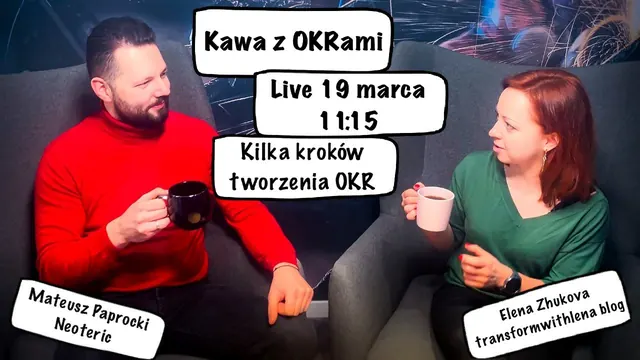 Coffee with OKRsSteps to creating OKRs
Steps back to before the workshop and shows what has to be ready before anyone writes the first sentence of an objective, including whom to invite into the room.
 Coffee with OKRs #46Who should you write OKRs with? Get ready for 2025
Answers the question of who takes part: who writes the annual goals, who writes the quarterly ones and from whom you gather knowledge before the session instead of seating them at the table.
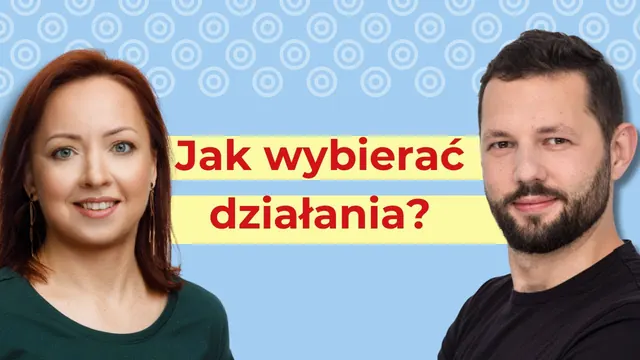 Coffee with OKRs #43How to choose what to act on?
A continuation of the same story, on the same example: how to choose actions for the quarter from a written objective, and why resource constraints are applied only after the ideas have been generated.
Author


Lena Zhukova
founder; strategy workshops, quarterly sessions
Founder of OKR Poland. For twenty years she has worked with boards of companies from 30 to a few thousand people; she wrote dozens of strategies with them and helped implement them in more than 40 organisations.
Next texts by e-mail
The OKR Poland newsletter
We write when we have something to say. To start: eight hours of recording on preparing a company for strategy workshops, plus the OnePager.