Coffee with OKRs · 6 min read
An objective's quality is decided before the workshop where you write it
A free slot in the calendar, a few people at a whiteboard and the assumption that the objectives will come up on the spot. That is what a good share of goal-writing sessions look like. The cost of such a meeting doesn't show up straight away, but in the middle of the quarter, when it turns out the wrong priority was chosen.
From the episode · in Polish
What you need ready before anyone writes the first sentence of an objective
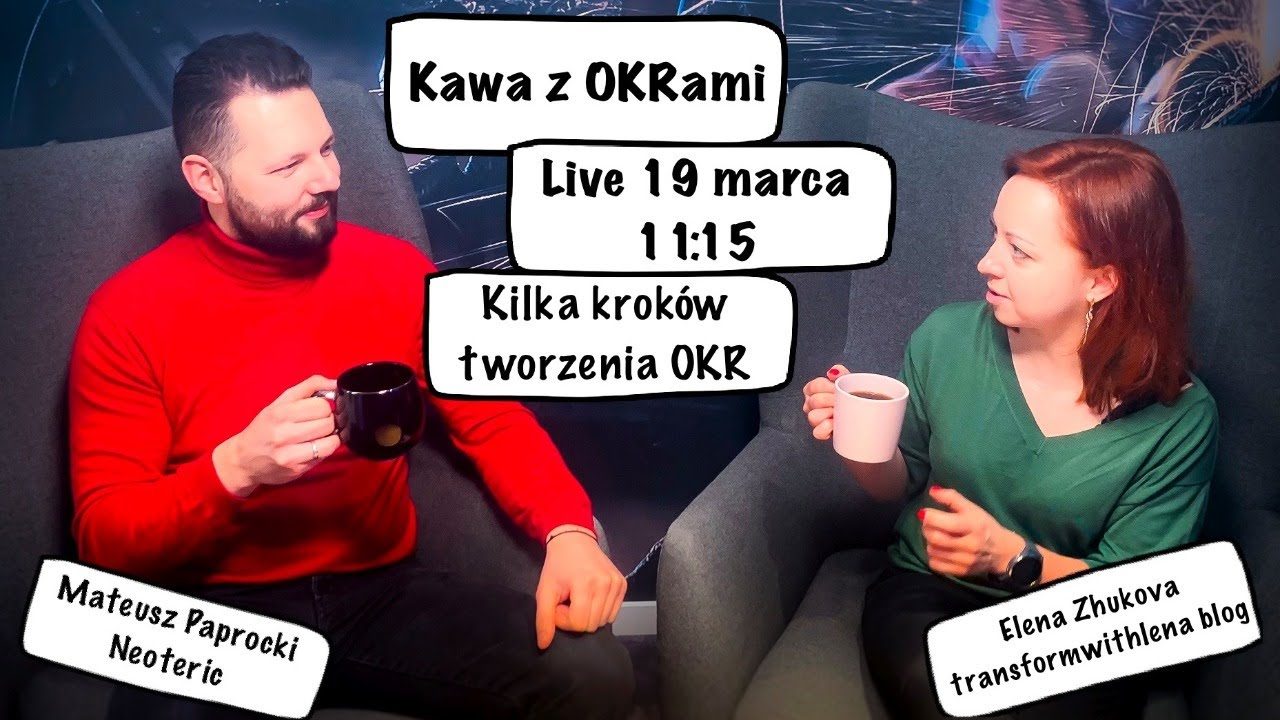
In the recording we go through the preparation step by step: what to gather before the meeting, whom to invite, what participants should send in advance, and what the quarterly sequence looks like, in which the board first holds its own retrospective and only then sits down with the leaders. The part about the threshold not being everyone's agreement comes in at around the twenty-fifth minute. from 00:24:29
 The recording is being edited. Leave your address and you'll get the link when it's ready.
This episode is entirely about what happens before the meeting where the objectives are created. The premise sounds uncomfortable for anyone who likes workshops: the wording itself is only a fraction of success, and the rest lies in the preparation. The first thing you need on the table is a direction. Not a thick document, but an answer to the question of which way the organisation is heading in the near future. If you don't have your strategy written down, you bring what you have: market data and signals from clients. A workshop without that material doesn't produce objectives, only wishes, because there is nothing to derive them from.
The second thing is the retrospective of the previous period, and not as a ritual that closes the quarter but as the input to the next one. What we are playing with today, what the biggest problem was, what we don't want to repeat. The third thing concerns the participants, though not their number, but what they come with. We ask everyone to put their list on a shared board before the meeting: what matters to them, what objective they propose, how they want to measure it and where it comes from. Along with that goes an agenda that says plainly what will happen and what we expect from each participant. Thanks to that the session starts with a conversation about priorities, not with filling an empty board. If there is nobody in the team who can lead that conversation, it is worth bringing in a facilitator who knows the method and can ask a guiding question.
There is one more thing that only shows with company-level objectives: they almost always cut across several departments at once. An objective around client satisfaction touches delivery, sales, which builds expectations before the contract is even signed, and administration, which closes the cooperation. A change in just one of those places won't move the indicator, because each holds only a piece. We made a mistake here ourselves at the start: we had no shared objective either at the level of the organisation or at the level of the leaders, and each division wrote its own. What fixed it was moving to one shared objective, set together by leaders from different areas. The last thing concerns agreement. In a larger group full unanimity is rare, and it isn't the threshold. It is enough for someone to say plainly that they disagree but understand the value and will do it. A disagreement spoken out loud is valuable information, too: it means that either something is wrong or there is something we don't know yet.
Takeaways
Four things that must be ready before the session
- 01
A direction or fresh data, but something has to be on the table
Without an answer to where the company is going, there is nothing to derive an objective from. When the strategy isn't written down, its place is taken by market data and signals from clients, because at least they tell you what is changing around you.
- 02
The retrospective is an input, not a closure
The conclusions from the previous period are input material for writing the next objectives. A session that starts from ideas instead of from them repeats the same problems and finds out about it after the quarter.
- 03
The material comes before the meeting, not at it
Every participant sends in advance their proposed objective, how to measure it and the reasoning, and the agenda says why you are meeting. Only then is the session a conversation about priorities, not collective invention from scratch.
- 04
Ask about the result, not the method
With every proposed objective the same questions come up: what will be the effect of this action, will it solve the problem and how will you know. We all tend to describe an objective through activity, through how we will work, rather than through what should come out of it.
The whole topic in one place
How to write OKRs?
This text ends at the moment the team sits down to write. What happens next, sentence by sentence, from a note about the company to a quarterly objective with a full set of metrics, we have described separately in the text on writing objectives. There we have also gathered links to all the conversations in which we touched on this thread.
Author


Lena Zhukova
founder; strategy workshops, quarterly sessions
Founder of OKR Poland. For twenty years she has worked with boards of companies from 30 to a few thousand people; she wrote dozens of strategies with them and helped implement them in more than 40 organisations.
Next texts by e-mail
The OKR Poland newsletter
We write when we have something to say. To start: eight hours of recording on preparing a company for strategy workshops, plus the OnePager.