Coffee with OKRs · 6 min read
Three retrospective questions only get you in. The value is in the fourth
You can leave an end-of-quarter retrospective with twenty corrective actions and change nothing. Choosing two or three is not a compromise or a sign of low ambition, it is part of the method. So is the question the whole meeting is meant to answer: why it worked, or why it didn't.
From the episode · in Polish
The end-of-quarter review from the inside, with the agenda and the traps
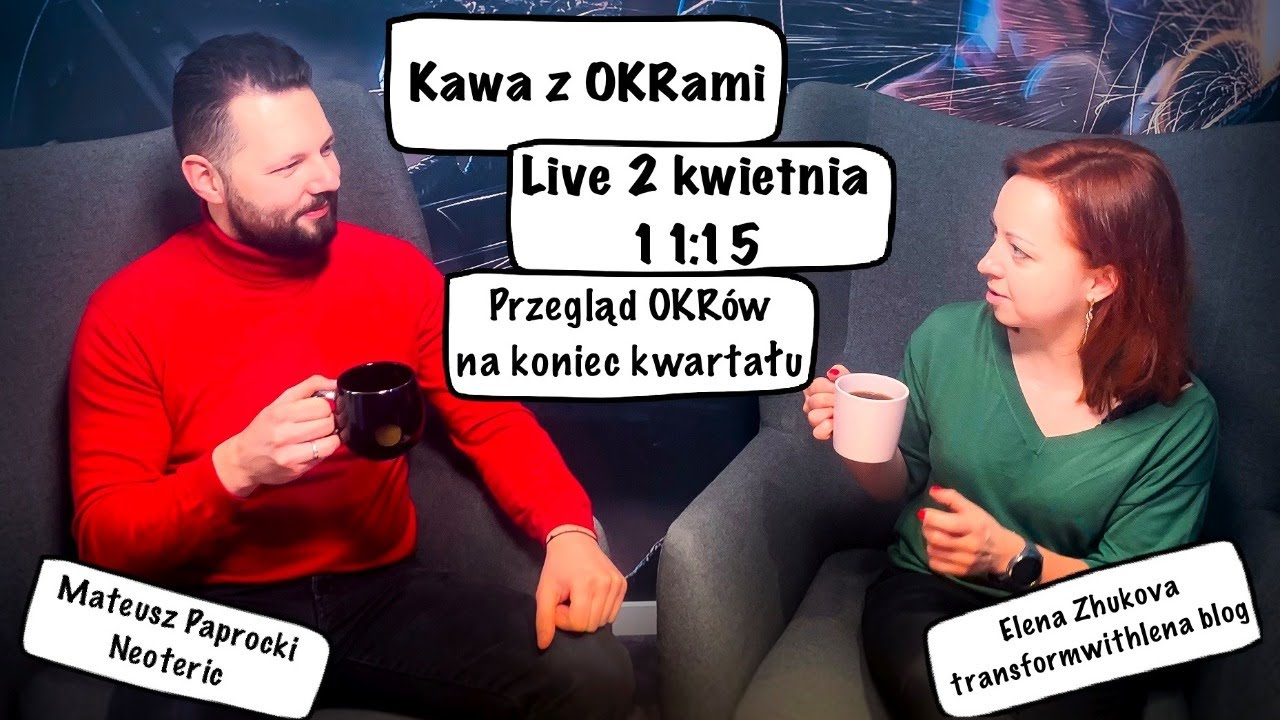
In this episode we take the review apart: an invitation sent at least a week in advance, the values of the key results already calculated, the three questions and the fourth, individual work before the group discussion, and choosing actions by voting and by rating impact against effort. The part about why it is worth setting objectives up as hypotheses from the start of the quarter, together with an example of a hypothesis tested on two axes at once, starts at around the fortieth minute. from 00:39:24
 The recording is being edited. Leave your address and you'll get the link when it's ready.
An end-of-quarter review contains two different meetings, and many companies hold only the first. The first is accounting for results: the values of the key results, the state of delivery, the numbers. The second is a retrospective of the process, a conversation about how we got to those numbers. In it the numbers are where the discussion starts, not the final truth, and that is exactly why it is better for someone other than the objective owner to present them. The person who carried the objective through the quarter is attached to it, which is normal, but it makes it harder for them to look at the result from the outside. It is also worth looking wider than the key results alone and asking what changed during the quarter in processes, in responsibilities and in the organisation itself.
A retrospective usually asks three questions: what to start doing, what to stop, what to continue. They are only the way in. The value is in the fourth, the question of why it worked and why it didn't, dug into layer after layer until the answer stops being a first reflex. For it to be answerable at all, the objectives have to be set at the beginning of the quarter as hypotheses to be tested. The review then stops being an argument about whether the objective was met and turns into a decision about the next step. In the episode we show this on a hypothesis about a chosen client segment, tested on two axes at once: whether enough clients of that kind can be won, and whether they can be served at the expected level. Confirmation of both meant scaling up in the following quarter. A stumble on the service side would have sent the work towards internal processes rather than sales.
The third thread is cultural, and it is the one that most often drops off the agenda. A review slides by default into looking for what went wrong, so a slot for successes has to be planned: twenty to thirty minutes in which everyone shares their own or praises someone else's. This isn't decoration. Good practices are what get scaled, and a practice nobody has named has no way of reaching the rest of the organisation. Connected to this is something I still have no good method for. At a joint retrospective with a leader and their direct reports in the room, you hear eighty per cent of the truth, and the twenty left unsaid is usually exactly what is blocking the team. One-to-one conversations before the meeting help, but they cost time, which at the end of a quarter is in shortest supply.
Takeaways
Four things that decide whether anything comes out of the review
- 01
Separate accounting for results from the retrospective
These are two different meetings, even if they take place on the same day. Have someone other than the objective owner present the results, and have the key result values calculated in advance. With a weekly update this shouldn't take any work at all.
- 02
An objective written as a hypothesis on day one of the quarter
Without it, at the end all you can say is that something was or wasn't met. With it, you can say what we do next and what the same work proved about our assumptions.
- 03
The fourth question, and digging
What to start, what to stop, what to continue, and then why. The first answer to why is almost never the right one, so the question has to be asked again, one layer further down.
- 04
Two or three actions, not twenty
Give people a few minutes of individual work, group the sticky notes, vote, and then rate the ideas by impact and by effort. You take the ones with high impact and low cost; the rest stays on the board, and that is fine.
The whole topic in one place
How we run an OKR quarter review
This text shows a single meeting from the inside and deliberately doesn't answer the question of how many such meetings should take place at the end of a quarter, or in what order. The answer to that is separate and is in the text on the quarter review: the cascade from working groups through leaders to the board, what travels back up together with the conclusions, and the full set of episodes in which we came back to this thread.
Author


Lena Zhukova
founder; strategy workshops, quarterly sessions
Founder of OKR Poland. For twenty years she has worked with boards of companies from 30 to a few thousand people; she wrote dozens of strategies with them and helped implement them in more than 40 organisations.
Next texts by e-mail
The OKR Poland newsletter
We write when we have something to say. To start: eight hours of recording on preparing a company for strategy workshops, plus the OnePager.