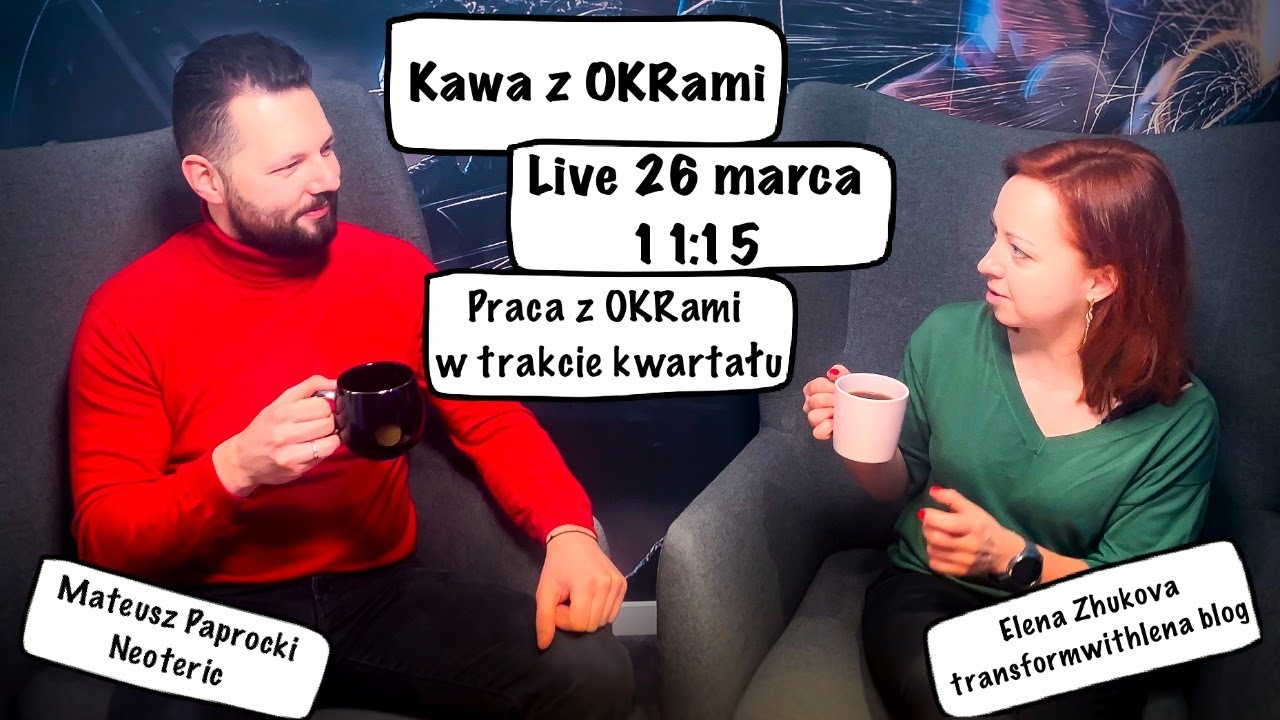
Coffee with OKRs · 6 min read
A quarter isn't decided by the goal-writing session, but by one fixed slot each week
The weekly cycle. Of all the work between writing the goals and accounting for them, this is the element that decides the rest. Not the tool, not how neat the wording is, not the number of columns in the spreadsheet. Regularity, and that holds just as much in a small organisation as in one with several dozen teams.
From the episode · in Polish
The quarter from the inside: who meets whom, at what point and why
In this episode we go through what happens between one planning session and the next: the roles during the quarter, the weekly update, linking iteration tasks to a specific goal, checking progress at the end of each iteration and choosing a tool. The part about regularity mattering most, not how neatly the goals are written, comes at roughly the sixth minute. The thread about what the weekly meeting is really for starts at around the twenty-seventh. from 00:27:14
 The recording is being edited. Leave your address and you'll get the link when it's ready.
In many companies, working with goals during the quarter looks like a second job. There is the team's normal rhythm: iteration planning, review, retrospective. And next to it stands separate reporting on goals, which you have to sit down to on top of everything else. That is the moment goals lose, because a second channel of information about the same work will never beat the first. This episode says something simpler: you plug the work with goals into the rhythm the team already has. Iteration tasks linked to a specific goal, so that you can see what they follow from. The question about the goal's progress asked at the same review where the team closes its tasks anyway. You don't need a hundred per cent of tasks linked to goals, because handling bugs and complaints happens alongside, and that is normal. What you do need is to take a step towards the goal in every iteration.
The second thing this episode turns over is the point of the weekly meeting. It looks like progress reporting, and that is exactly why it is often the first thing teams want to shorten or cancel. Its value lies elsewhere: in someone hearing what another person is working on and saying they are doing the same thing on their side, or that the same effect can be achieved by a completely different route. For that to happen, people have to come with the data already calculated, not work it out on the spot. That is why the order within the week matters: teams update among themselves earlier, and the joint leaders' meeting takes place later the same day.
The third thing concerns when you check. We verify a goal's progress at the end of each iteration, that is every two weeks, sometimes every four, not at the end of the quarter. Waiting until the end always ends the same way: surprise that the goal hasn't moved. When something hasn't moved, we ask why, because sometimes the answer is that it wasn't important enough, and then the problem lies not with the team but with the definition of the goal. There is one more thread in this episode, and I talk about it with some unease, because it is hard to sell. The aim of the person responsible for the implementation is to bring the organisation to a state in which they are no longer needed, and their scope should shrink from quarter to quarter. In an organisation of around a hundred people, the champion and the goal owner can be the same person, and that is enough. After a few quarters you can see whether it is going well: teams define goals themselves, know the assumptions of the strategy and talk about results instead of activities.
Takeaways
Four things that hold the quarter together between one planning session and the next
- 01
A fixed slot, not a fixed willingness
Set the day and time of the weekly update and treat them as untouchable. Regularity matters more here than the tool and than how nicely the goals are written. Only when the rhythm no longer needs anyone to police it does it become a habit of the organisation.
- 02
Plug goals into the rhythm the team has
Iteration planning, review, retrospective. Tasks linked to a specific goal, so that you can see what they follow from. Goals run as separate reporting alongside normal work lose to it every week.
- 03
The meeting is for communication across
Not for reporting progress. Give teams time for their own update earlier, so that they come to the joint meeting with the data already calculated and have the energy to listen to one another instead of reading out numbers.
- 04
The simplest tool to start with
The cost of learning an elaborate system is paid before the first benefit, and nobody has to learn a spreadsheet. Change the tool only when scale really demands it, and don't judge the situation by the colour of an icon.
The whole topic in one place
How we run an OKR quarter review
The weekly rhythm is half of this story. The other half happens at its end, when the conclusions from the quarter have to travel further than the team that drew them. We have set this out separately, in the text on the quarterly review: the cascade of retrospectives from working groups up to the board, the full set of things to prepare, and what comes back up from them. That is also where you will find the list of all the episodes in which we talked about the rhythm of the quarter.
Author


Lena Zhukova
founder; strategy workshops, quarterly sessions
Founder of OKR Poland. For twenty years she has worked with boards of companies from 30 to a few thousand people; she wrote dozens of strategies with them and helped implement them in more than 40 organisations.
Next texts by e-mail
The OKR Poland newsletter
We write when we have something to say. To start: eight hours of recording on preparing a company for strategy workshops, plus the OnePager.