Coffee with OKRs · 5 min read
A good OKR champion works towards no longer being needed
At the start of an implementation, while the company has no habit yet, this role looks unglamorous. Someone puts meetings in everyone's calendars, from the board to the teams, prepares the agenda and shows live how to run such a meeting from start to finish. That is a good place to begin, because the champion's role is often understood the exact opposite way.
From the episode · in Polish
The whole role up close, from the first entry in someone else's calendar to the moment it is no longer needed
An hour on a single role: where it comes from in companies, what a typical quarter looks like for the person who holds it, and where to look for candidates. The part singled out in the episode as the one to remember if only one sentence were to stay, that this isn't the role of an expert in the method, is in the eighteenth minute. The description of a typical quarter begins close to the twenty-eighth. from 00:18:11
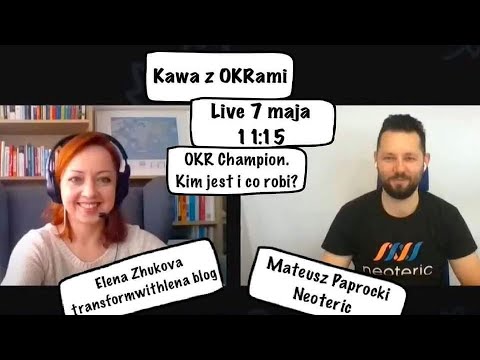 The recording is being edited. Leave your address and you'll get the link when it's ready.
First, what it is not, because this is where companies most often get it wrong. The champion is not an expert in the method or its evangelist. When they become one, the thing described by the saying about the man with a hammer happens: every problem in the organisation starts to look like a problem to be solved with objectives. Hence two traps we name plainly in this episode. The first is turning the role into administering the process: calendars, templates and checking how well-known companies do it, instead of looking at your own organisation as a living mechanism and finding the places in it that need support. The second is perfecting the method itself, meaning a great deal of time spent on how best to write an objective, with zero movement in the direction the company was meant to go. I name both from the inside, not from the sidelines. We can sit over a single sentence of an objective for longer than we would care to admit, and even knowing the theory, we can justify to ourselves a return to the old habit.
So what does this person do. Their quarter starts a month before the end of the previous one: the quarterly and annual retrospective, plus a review of whether the strategy still holds, what the financial situation looks like and what is happening in the external and internal environment. Then planning, in which everyone first prepares their own versions of objectives, and only then does everyone sit down to negotiate. On top of that, alignment on two axes: vertically, whether all the teams are really heading in the same direction, and horizontally, what the teams from one division contribute to the same objective. Then an information session for the whole company, in the form of a webinar with time for questions and doubts, after which it sometimes turns out that the objectives themselves still need correcting. During the quarter there is one-to-one work with the objective owners, led by questions: why this metric in particular, why this way, from when do you want to measure it. Answering them is in itself a way of learning the method, more effective than training. And one thing checked every week: that the conversation is about results, not about a list of actions completed.
Who is suited to it. The criterion isn't knowledge of the method but an understanding of the strategy and the business, plus soft skills, so a champion can come from the board, from a product role, from being a scrum master or from a unit that supports the rest of the organisation anyway. It isn't a full-time post. In a company of more than 800 people there are several champions, from different locations, each doing it alongside their normal work, and they share knowledge among themselves. The name of the role doesn't matter, and neither does the name of the method itself: a team that adapted the tool to its own context after the workshops and gave it its own name is closer to the goal than one that faithfully reproduces the textbook.
Takeaways
Four signs that the role is well understood
- 01
The measure of success is making yourself unnecessary
The whole job is to bring about a situation in which this person is no longer needed, because the habits and skills sit in the people. Working with objectives then stops being a method we apply and becomes a way of steering the strategy.
- 02
Without the board the role has nothing to look after
Persuading starts at the very top. An implementation run mechanically, without someone who understands the point of it, burns out after one or two quarters, and the organisation goes back to what it did before.
- 03
It is an additional role, not a position
With more than 800 people there are several champions, and each plays the role alongside other work. Fill it according to an understanding of the business and strategy, not according to knowledge of the method or a ready process plan in someone's head.
- 04
Conclusions from retrospectives can't stay in the teams
Gather them from the whole organisation and look for what they have in common. One team's conclusion can be a matter for the whole company that needs a response, and on its own it won't get anywhere.
The whole topic in one place
What can an OKR owner do to make OKRs work?
The champion isn't the person who delivers the objectives. They are the one who makes sure there is someone to deliver them. Who takes an objective on by name, where the line runs between the objective owner and the owners of the key results, and what needs to be set up around a single key result so that the quarter doesn't fall apart, we take apart in the text on the objective owner. There you will also find all the episodes in which we talked about roles.
Author


Lena Zhukova
founder; strategy workshops, quarterly sessions
Founder of OKR Poland. For twenty years she has worked with boards of companies from 30 to a few thousand people; she wrote dozens of strategies with them and helped implement them in more than 40 organisations.
Next texts by e-mail
The OKR Poland newsletter
We write when we have something to say. To start: eight hours of recording on preparing a company for strategy workshops, plus the OnePager.