Coffee with OKRs · 4 min read
An indicator shows where you are now. An objective is about what isn't there yet
The board announces: 5 million in revenue this year, a million of it in the first quarter and two in the second. The rest of the organisation is left to work out how. This is a route we explicitly don't recommend in this episode, and the reason is more practical than theoretical: the team gets a number it has no influence over.
From the episode · in Polish
The shortest coffee in the whole series, one topic for thirty minutes
The board's responsibility and the organisation's habits open the conversation in the sixth minute, the distinction between horizons, together with the line about pasting indicators into key results, starts in the ninth, the analogy with a car's dashboard in the twelfth, and the thread about how slowly relationship indicators move at around the twenty-first minute. from 00:09:06
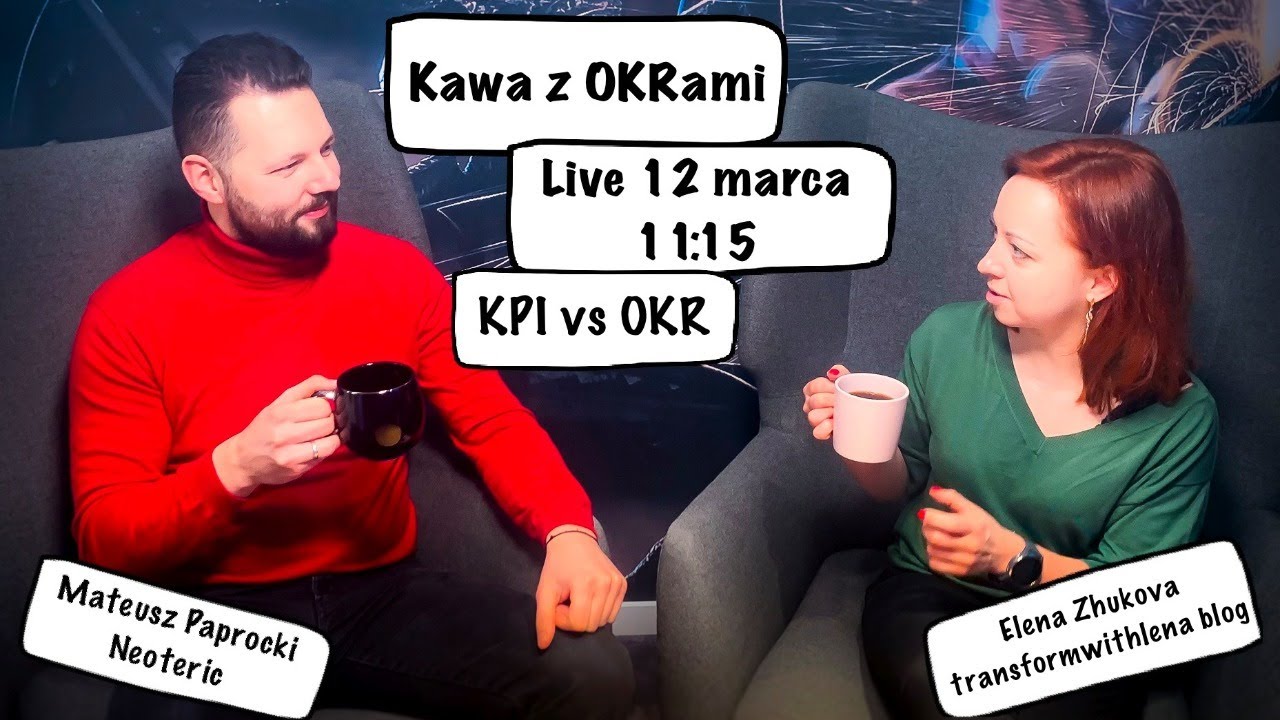 The recording is being edited. Leave your address and you'll get the link when it's ready.
The difference between an indicator and an objective is a difference of horizons, and everything else follows from it. A key indicator shows where we are right now, and it won't tell you where we will be in a month. An objective is about something that has yet to happen, because OKRs are a tool for implementing strategic plans. In the episode we explain it with driving a car: the objective is the place you are driving to, and the dashboard monitors the fuel and the state of the engine. As long as nothing is flashing, you don't deal with it. Only when something breaks and fixing it becomes a condition for going further does the indicator get promoted to an objective. That was the case in a situation where, over several consecutive quarters, handling time kept rising and clients' willingness to recommend the company kept falling, until improving the team's efficiency became a quarterly objective.
Hence the practical rule of this episode. An indicator as inspiration for an objective is fine, but pasting it in directly as a key result is a recipe for failure. The team then gets a number it has no direct influence over, most often revenue or cost, while it works better on something within its control. The whole difference sits in the question. I want to have this number is one perspective. What do I need to change in my organisation for this to happen is another, and they are two completely different perspectives. An organisation has its behaviours in sales, in marketing, in customer service, and these are what we call habits. Pointing to the habit to be changed is the board's responsibility. Handing down the number alone is not.
The third thing concerns time, and it is the one most often brushed aside. Relationship indicators have a lot of inertia. The question about willingness to recommend the company to friends and family is asked on a scale from 1 to 10, and any answer below 8 should be a warning sign, but improvement doesn't happen overnight: first an audit of the causes, then a plan, then implementation, and the effect shows in the following quarters. Expecting an indicator like this to rise by 3 to 4 points in a single quarter is unrealistic. Alongside the objective, though, it is worth keeping a second number: what must not break during this change, such as application availability, client retention, quality of service. And one remark that applies to us too: we tend to measure lots of things that have no significance for the business, instead of a few that do. Measuring for the sake of measuring is a separate problem, and no method cures it.
Takeaways
Four things to take from this episode
- 01
An indicator becomes an objective only when it breaks
As long as everything works, you monitor it and don't deal with it. It becomes an objective at the moment its state blocks the way ahead, and then it is a justified choice.
- 02
An objective without a lever is not an objective
Revenue and cost thrown at a team as a key result give it a number it has no direct influence over. A team works better on something it has under its control.
- 03
The board points to a habit, not just a number
The board's responsibility is choosing the behaviour of the organisation that is to change. Giving a number and leaving the rest of the company to guess how to deliver it doesn't fulfil that responsibility.
- 04
An indicator with a lot of inertia won't move in a quarter
First an audit of the causes, then a plan, then implementation, and the result comes in the following quarters. An improvement of 3 to 4 points by the end of the quarter is an expectation that can't be delivered.
The whole topic in one place
What are OKRs? A refresher
If what you are looking for is not so much the difference between an indicator and an objective as an answer to the question of why a company needs these goals at all, take a look at our most recent take on the basics. There the topic is covered in full, together with pointers to the other episodes on the same subject.
Author


Lena Zhukova
founder; strategy workshops, quarterly sessions
Founder of OKR Poland. For twenty years she has worked with boards of companies from 30 to a few thousand people; she wrote dozens of strategies with them and helped implement them in more than 40 organisations.
Next texts by e-mail
The OKR Poland newsletter
We write when we have something to say. To start: eight hours of recording on preparing a company for strategy workshops, plus the OnePager.