Coffee with OKRs · 4 min read
The surest way to put people off goals is before anyone writes the first one
The organisation works in monthly cycles, and the goal reviews have been copied from the textbook, meaning every week. They land in the middle of the cycle and clash with the process that is already there. The first sign of discouragement then sounds like this: there are too many of these meetings and they are pointless. And the team is right.
From the episode · in Polish
Cards turned over one by one, and the moment they fall into phases
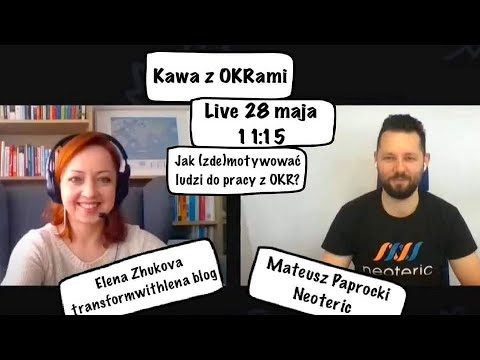
The episode is a card game. We turn over one behaviour after another that can put a team off working with goals, and at each one we stop at what is missing underneath it. The metaphor of a driver who turns differently at every bend and expects the passengers to raise their hands keeps coming back, a picture of working with goals when the direction changes every month. The most useful part is the end: we sort the cards into phases, you can see how many of them sit before the start, and then we say where to begin when the method is already limping. from 00:48:27
 The recording is being edited. Leave your address and you'll get the link when it's ready.
This episode is built the other way round from a how-to guide. Instead of a list of good practices, we turn over card after card with behaviours that are very effective at discouraging a team, and almost none of them is a flaw in the method. Usually it is the absence of something that should have happened around it. A tool chosen because another company uses it, without checking whether it fits with everything else or whether a spreadsheet the team already knows would do. Then automatic emails reminding people to fill in data that nobody fills in, because the tool doesn't fit their day-to-day work. Or an objective where only at the final reckoning does it turn out there was no way to tell whether it had been achieved, so half the team is convinced it went well, the other half that it didn't, and the conversation drifts from facts to interpretations.
Under most of the cards sits the same asymmetry. On the board, thinking about direction comes naturally, because there is time for it. An operational person has no moment to step out of their own seat for a while and look at the organisation from the side, and learning only fits into their working hours, because after them there is home and the rest of life. Expecting engagement without a signal, without training and without making room for it is therefore lost before it begins, and the leader's role here is to make things easier, not to demand. The hardest part of the whole cycle turns out to be not planning but drawing conclusions, because it requires admitting discomfort and making decisions. We naturally choose comfortable conclusions and don't name the problem everyone is aware of. The episode also raises a question that is not usually asked aloud: is it the method that isn't working for the team, the way it is run, or the limitations of the person who watches over the process and can't let go.
When we finally sort these cards into phases, something comes out that surprised even us: most of them land before the first quarter. No answer to the question of why we are implementing the method at all, and no metric by which we will know it helps. No strategy for the goals to relate to. No decision by the board to genuinely hand over responsibility, because a declaration of trust alone doesn't replace it. And rolling it out across the whole company at once instead of a pilot, after which the problems of all teams surface at the same moment, and in the end people complain about communication. These gaps aren't visible in phase zero, because nothing is happening yet. You pay for them through all the quarters that follow.
Takeaways
Four things that are settled outside the method itself
- 01
Phase zero decides the quarters that follow
Why we are implementing, how we will know it helps, what the strategy is, whether the board is ready to hand over decisions and whether we start with a pilot. These answers can't be made up for later on the run.
- 02
Cadence from the company's rhythm, not from the book
Reviews copied from the textbook against the cycle in which the organisation actually works produce meetings rightly seen as pointless. Before you choose a tool, check in the same way whether what the team already uses would do.
- 03
Responsibility without decision-making power disarms the whole structure
The reverse variant works the same way, wanting to decide without taking responsibility, and so does appointing a person to run the process without taking at least some of their existing duties off them.
- 04
Repair starts with what works
Attention drifts to faults by itself, so the good patterns in an organisation usually go unnoticed, and they are the material for strengthening. And don't assume that a satisfied board means it works in the organisation; ask people.
The whole topic in one place
Why don't OKRs work in my company? An implementation audit
The list of discouraging behaviours describes symptoms, which is why it is easy to recognise in your own company. The causes lie one floor down, and we take them apart pillar by pillar in the text on auditing an implementation. The other episodes on why implementations stall are gathered there too.
Author


Lena Zhukova
founder; strategy workshops, quarterly sessions
Founder of OKR Poland. For twenty years she has worked with boards of companies from 30 to a few thousand people; she wrote dozens of strategies with them and helped implement them in more than 40 organisations.
Next texts by e-mail
The OKR Poland newsletter
We write when we have something to say. To start: eight hours of recording on preparing a company for strategy workshops, plus the OnePager.