Coffee with OKRs · 6 min read
Motivation can't be added once the objective is written. It comes from three decisions made before the quarter
The kick-off lasts five minutes. The objective owner reads it out from a sheet of paper and asks if there are any questions. The team received no materials beforehand, so there are no questions. For the next three months someone in this company will be wondering why these people aren't engaged.
From the episode · in Polish
Three decisions and two silent killers of motivation
In the recording we take apart each of the three decisions, distinguishing between companies of different sizes, and show what negotiating an objective with a team looks like step by step. It includes a responsibility matrix, meaning who is accountable for the result, who does the work, whom we consult and whom we only inform, as well as a tip on what to do when the owner of a key result doesn't feel up to being a leader. The part on people's availability is the strongest moment of the whole conversation. from 00:33:21
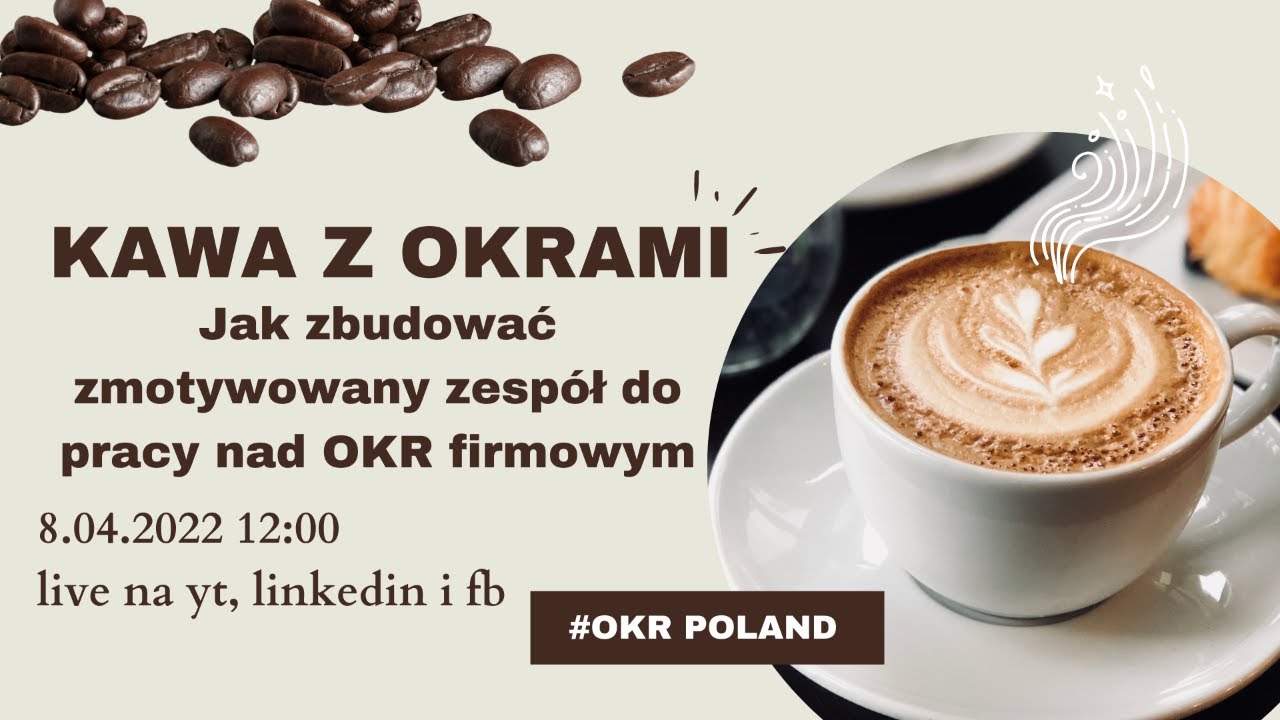 The recording is being edited. Leave your address and you'll get the link when it's ready.
The first decision concerns who writes the objective. A sense of agency comes from two things: the objective wasn't imposed, and the way of achieving it stays in the team's hands. That is why in no way of working I know of are objectives created by the board alone. The order matters too: first the objective as a business result for the company, and only then the choice of people. The reverse order, writing objectives so that every department has its own, builds nothing but silos. The negotiation of the objective itself can't be reading it out from a sheet of paper. It needs the whole story, from the vision, through the strategy and the clients, to why this particular quarterly objective moves the annual goal forward. And it needs the sentence that is said least often: that this is a draft, not the final version. Without a sense that the objective can still change, nobody will give you a valuable contribution. Send the materials a few days in advance, not the evening before a morning meeting, and make sure the person actually has time to read them and isn't busy putting out a fire at a client's.
The second decision is context. Companies expect engagement with goals without giving people the information they would need to think. The board says everything is clear, while in practice the strategy is written down nowhere, sits in the heads of two people, or changes every other moment. The proof that the context has really got through is easy to recognise, and it appears only during planning. Someone says then that we won't do something because it doesn't fit our strategy. That is the moment when the weight of the decision stops resting on the leader alone, because in an informed team there will be people who point out what the leader didn't take into account. I don't have one answer to how widely to involve people in writing objectives, because it depends on the size of the company. It looks different below twenty people, different between twenty and two hundred, and different again above that.
The third decision is the make-up of the team, and it has three layers, not one. Skills are obvious. The second layer is availability, and this is where the sharpest sentence of the whole episode comes: setting objectives while ignoring people's availability is a ready-made recipe for failure. If you need someone from a given department, you have to take duties off them or free up their time in some other way. You don't assume the time will turn up. There are teams whose work consists of supporting the rest of the organisation, and by nature they have little room for development objectives. The third layer is natural working styles, because a team made up only of analysts will search for the best route, and a team made up only of activators will launch a hundred actions at once. On top of that come two mechanisms that quietly kill motivation. Cascading objectives down successive levels of the structure turns work on the objective into administering objectives: multiply the leaders by the number of key results, and you will see how much of it becomes ordinary paperwork. The second is a bonus system that rewards something at odds with the strategic goal.
Takeaways
Four decisions made before the team starts working
- 01
Agency instead of incentives
An objective created together and a way of achieving it that isn't imposed give people attachment to the objective and acceptance of responsibility. Adding incentives after the fact can't replace taking part in creating it, because by then the decision has been made.
- 02
Context before expecting engagement
A team that knows the vision, the strategy and the clients can say what it won't do and why. If sentences like that don't come up during planning, the context hasn't got through, even though the board is convinced everything is clear.
- 03
Availability is a layer of selection, not a detail
Skills, time availability and natural working styles. The middle layer is skipped most often and costs the most, because it requires actually taking duties off someone, not a declaration.
- 04
Check what you are paying people for
A bonus for the number of calls made, alongside a strategic goal that says something else, sets a person against the goal. They will be naturally motivated to do the thing we don't want, and there is no ill will in it at all.
The whole topic in one place
Why doesn't the team deliver on its goals? Looking for the cause
If after this list you have the impression that motivation is only one of several fronts, that is the right impression. The same teams later stumble over an objective that never became an agreement, over the lack of a picture of the quarter as a whole, and over meetings reduced to reading out status updates. We have gathered this whole topic, together with the episodes in which we took it apart piece by piece, in the text the button next to this leads to.
Author


Lena Zhukova
founder; strategy workshops, quarterly sessions
Founder of OKR Poland. For twenty years she has worked with boards of companies from 30 to a few thousand people; she wrote dozens of strategies with them and helped implement them in more than 40 organisations.
Next texts by e-mail
The OKR Poland newsletter
We write when we have something to say. To start: eight hours of recording on preparing a company for strategy workshops, plus the OnePager.