Coffee with OKRs · 5 min read
A request for OKRs is usually a symptom, not a diagnosis
The first question we ask a company that wants an implementation is: why do you want to implement them, and what is on your mind that made you start thinking about it at all. The answer settles more than the whole rest of the conversation. In this episode we take 10 genuine reasons people come to us with, and for each one we say whether this is the tool for that problem.
From the episode · in Polish
Ten reasons for an implementation, each with a verdict
The episode goes one by one through ten beliefs that companies come to us with when they want OKRs. The opening question comes in the third minute, the requirement of a single metric per key result in the ninth, the sharpest verdict on control and performance management in the fifteenth, the thread on aligning the tool with leadership style in the twenty-first, and the image of OKRs as an umbrella that opens up the organisation's dysfunctions at around the thirty-ninth minute. from 00:15:08
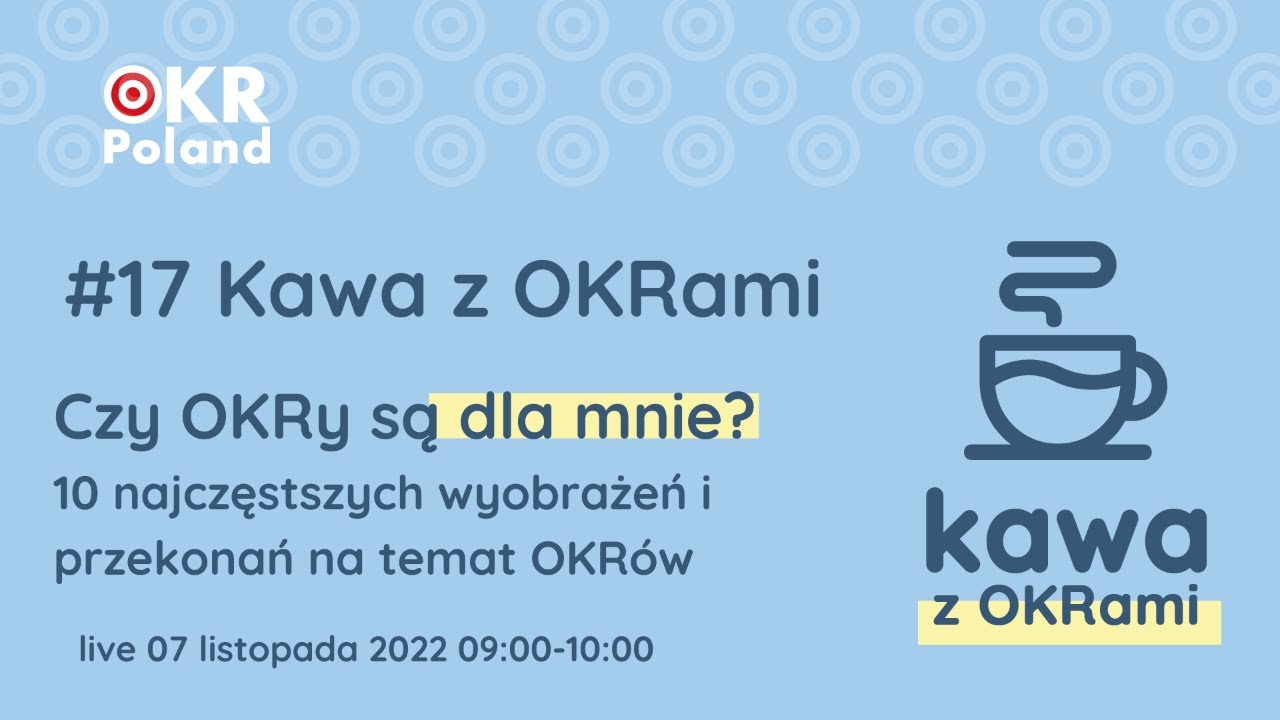 The recording is being edited. Leave your address and you'll get the link when it's ready.
The split comes out sharper than we expected. OKRs help where the point is implementing and communicating strategy down through the organisation, cooperation and the flow of information between teams, clearly handing over responsibility, an objective answer to the question of where we are in delivering a goal, and organisational learning. They don't help, and sometimes do outright harm, where the point is daily reporting on people's work, managing the performance of individuals, running projects, building an organisational structure and developing management skills. Each of these rejected needs has its own tool, just not this one. It is also worth knowing how long it takes to reach a mature arrangement: one of the organisations described in the episode took 5 years to get to a model in which leaders work out the quarterly goals and the role of the chief operating officer comes down to checking whether the workshop is consistent with the annual goal and the strategy.
The sharpest verdict concerns control. Companies come to us wanting a daily report on their people's work, one hundred per cent transparent reporting of designers' work split into project and non-project time, and a wish to measure whether individual people have achieved their goals. That is not a need for OKRs but for a work planning tool and for performance management, and in this form it is micromanagement disguised as a modern method. We tell clients that plainly. It is similar with a young organisation that came for goals in order to build itself a stable structure: a structure organises functions, reporting lines, individual development and formal requirements, while goals organise people across departments, so here they are more likely to get in the way. Projects are managed with something else too. In this arrangement a goal is a filter that tells you whether a given initiative supports the strategy, and that is where its role ends.
That leaves the question of what an implementation gives you, then, if it doesn't take care of so many things. It works like an umbrella: it opens up the organisation's dysfunctions and lets you name them, but it doesn't fix them itself, so the holes are then patched with other techniques. The strongest example in this episode comes from the hosts' own back yard. Even before implementing goals, they laid out responsibilities in their own organisation with a role matrix, and something came out that nobody expected: it seemed the work was spread more or less evenly, and it turned out that individual people were wearing 5 or 6 hats at once and they were the bottleneck. Another organisation discovered on the same occasion that its teams, split into small groups working mechanically, each on its own, had simply stopped talking to one another. It only came out when the shared product was being put together and the whole thing didn't work.
Takeaways
Four things to take from this episode
- 01
Start with the question of why you want to implement them
Write the reasons down on sticky notes with the board and the leaders, group them and agree how you will know the implementation has worked. Without that you are implementing a tool for an unnamed problem.
- 02
A need to control people's work is not a need for OKRs
A daily work report, holding individuals to account for goals and tying their indicators to a bonus is performance management. It has its own tools and is better kept separate.
- 03
Goals won't build a structure or run projects
A structure organises functions and reporting lines, while goals organise people across departments, so the two will get in each other's way. Projects are managed by a project methodology, and a goal is a filter for whether an initiative supports the strategy.
- 04
The tool should fit the leadership style
For a leader who wants to make decisions alone, goals are more likely to get in the way, because they encourage autonomy and teams taking on responsibility. Neither approach is wrong in advance, but it is worth choosing the tool to fit who we really are.
The whole topic in one place
What are OKRs? A refresher
The basics, that is, what these goals are in the first place and how they connect with strategy, were deliberately left to one side here, because the whole episode is a test of fit. We round off the topic itself in a separate text, together with a pointer to the other episodes in which we came back to it.
Author


Lena Zhukova
founder; strategy workshops, quarterly sessions
Founder of OKR Poland. For twenty years she has worked with boards of companies from 30 to a few thousand people; she wrote dozens of strategies with them and helped implement them in more than 40 organisations.
Next texts by e-mail
The OKR Poland newsletter
We write when we have something to say. To start: eight hours of recording on preparing a company for strategy workshops, plus the OnePager.