Coffee with OKRs · 6 min read
An OKR rollout isn't decided by the goals, but by whether people come to the check-in prepared
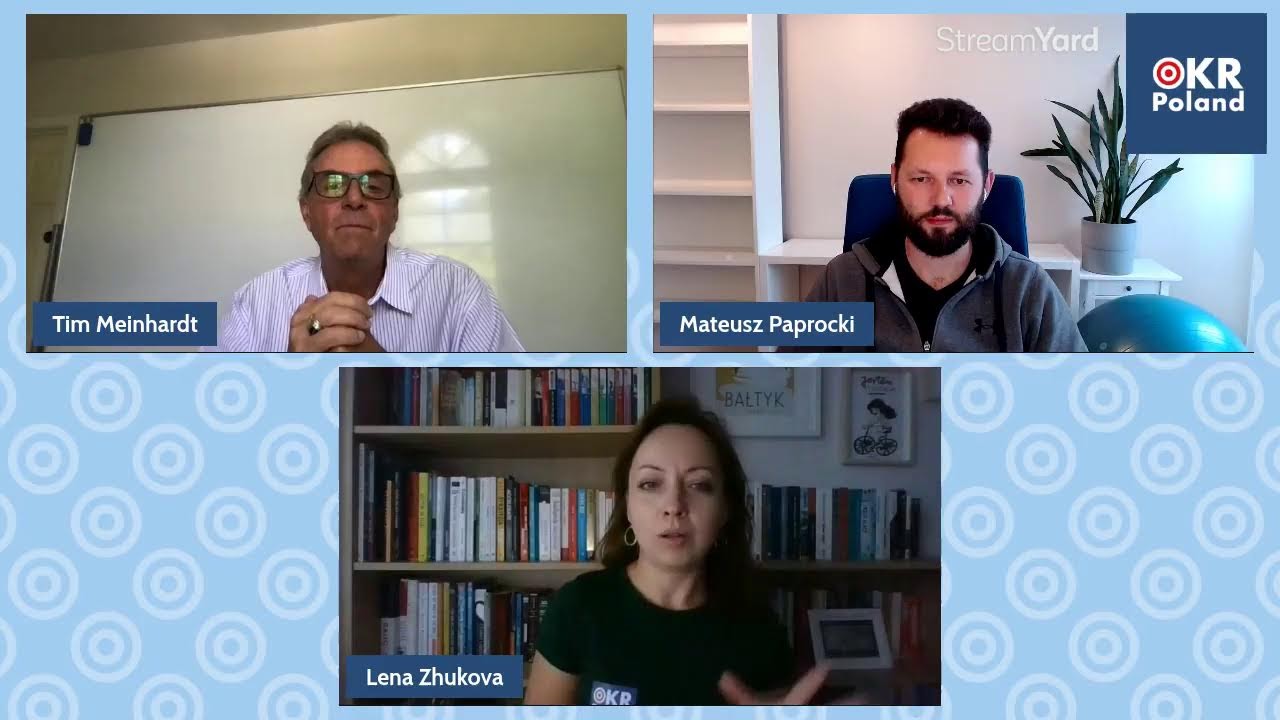
The share of failed OKR implementations sits somewhere in the seventy-something per cent range, and the causes keep repeating. That figure comes up in a conversation that is an exception in our series: the recording is in English, and the guest is Tim Meinhardt, head of a consulting firm and host of a podcast about OKRs, who has led implementations in companies with revenues from two and a half million to nine billion dollars.
From the episode
The whole conversation about strategy execution, in English
The recording is entirely in English and is the first English-language edition of the series. In it we talk about the conditions for an OKR programme to succeed, about how to run a check-in so that it stays within its time, about the sponsor on the board and about the leader who just goes through the motions. The part about consistency, a fixed slot and how to tell that the programme is alive starts at roughly the twenty-seventh minute. The figure on failed implementations comes up at around the thirty-third. from 00:27:11
 The recording is being edited. Leave your address and you'll get the link when it's ready.
The question about the number one habit gets an answer in this conversation that you won't find in any guide to writing goals. It is consistency. A fixed slot for a short check-in, one everyone knows without looking at the calendar, instead of a meeting that has to be squeezed in somewhere every week. The health metric for the programme is simpler than companies would like it to be: attendance and preparation. If people turn up and know what they are talking about, the programme is alive. If every other person turns up and only remembers on the spot what has happened over the last two weeks, there is no point in polishing the wording of the goals, because the problem is somewhere else. For this to work, the meeting has to stay within its time: four minutes per person, questions held until the end, other topics put on a list for later. With prepared people, eight to ten people fit into thirty-five minutes, and seventeen into an hour.
The second point overturns the most common objection to the check-in, namely that it is one more meeting added to people's workload. It is meant to replace meetings, not to add to them, because a conversation about what matters most right now makes some other conversations unnecessary. In the episode there is the story of a sceptical manager who was just going through the motions with the programme, and after two weeks came of his own accord to say he was convinced, because thanks to one check-in he had cancelled three meetings a week. Underneath sits a change that is harder than the method itself: moving from reporting what we have done to talking about where we want to be at the end of the quarter and how confident we are of it. It sounds like a small matter of wording and it isn't, because it forces a projection where people have been trained to give an account.
The third thread concerns people, and here the conversation gets uncomfortable. Without a sponsor on the board who commits their time, not just their approval, the programme doesn't go beyond an operational slice and never touches the strategy. A leader high up in the structure who only goes through the motions with goals is not a local problem, because it spills over into everything below them, and you have to sit down with them in private instead of waiting for it to sort itself out. The framework gives guidelines, not rules, so every organisation makes its own version within the set lane, and the biggest source of failure is people who have read the book, turned it into a rigid code and start using it to steer others. For years I kept telling workshop participants that they had to come prepared, and I felt it was my own organisational quirk. One of the teams I work with shortened its quarterly goal-writing session over three quarters from two days to two or three hours. Not because it learned to write goals better, but because it learned what to prepare before the meeting and what information to look for.
Takeaways
Four things that decide a rollout before anyone writes the first goal
- 01
A sponsor gives time, not approval
The board's approval is enough to get started and for nothing more. Without someone at the top who commits specific time, the programme stays in a small, closed operational space and never reaches the level of strategy.
- 02
Attendance and preparation as the metric
Not the degree to which goals are achieved. From whether people come to the check-in and whether they know what they are talking about, you will learn the state of the programme sooner than from any summary of results.
- 03
Don't tie goals to pay
A system that rates the degree of achievement rewards whoever didn't take a risk. One person takes a big risk, gets to seventy per cent and shows amber, another takes a small step and shows green. Say this plainly at the start of the programme.
- 04
Roll out in layers and deal with the sceptics
Letting the whole organisation in at once produces chaos that can't be brought under control. First build a few evangelists among senior people, and give the biggest sceptics more attention than everyone else, because they are the ones who later defend the tool most strongly.
The whole topic in one place
How we run an OKR quarter review
This conversation looks at rhythm from the perspective of the whole programme and says how to tell that it is alive. It doesn't say what the end-of-quarter agenda looks like in practice. We set that out in the text on the quarterly review, and that is where the topic of cadence is rounded off: the order of the meetings, the input for each of them and a list of all the episodes in which we talked about the rhythm of the quarter.
Author


Lena Zhukova
founder; strategy workshops, quarterly sessions
Founder of OKR Poland. For twenty years she has worked with boards of companies from 30 to a few thousand people; she wrote dozens of strategies with them and helped implement them in more than 40 organisations.
Next texts by e-mail
The OKR Poland newsletter
We write when we have something to say. To start: eight hours of recording on preparing a company for strategy workshops, plus the OnePager.