Coffee with OKRs #60 · 5 min read
A strategy workshop is for decisions. Gather the data before it, not during it
Getting the whole board and the directors into one room is the most expensive and hardest to come by resource a company has. You can waste it in the first hour: all it takes is to open with the question of what products, markets and challenges the company has. That is not the start of work on strategy, it is quizzing the board about its own company.
From the episode · in Polish
Seven blocks of questions, one block at a time
The whole episode walks through the preparation list: we put up one block after another and for each we say what exactly to ask and where to get the answer. The list itself starts at around the ninth minute, right after it comes a conversation about how a mission differs from a slogan on the wall, and the lessons from the last twelve months close the recording. from 00:09:05
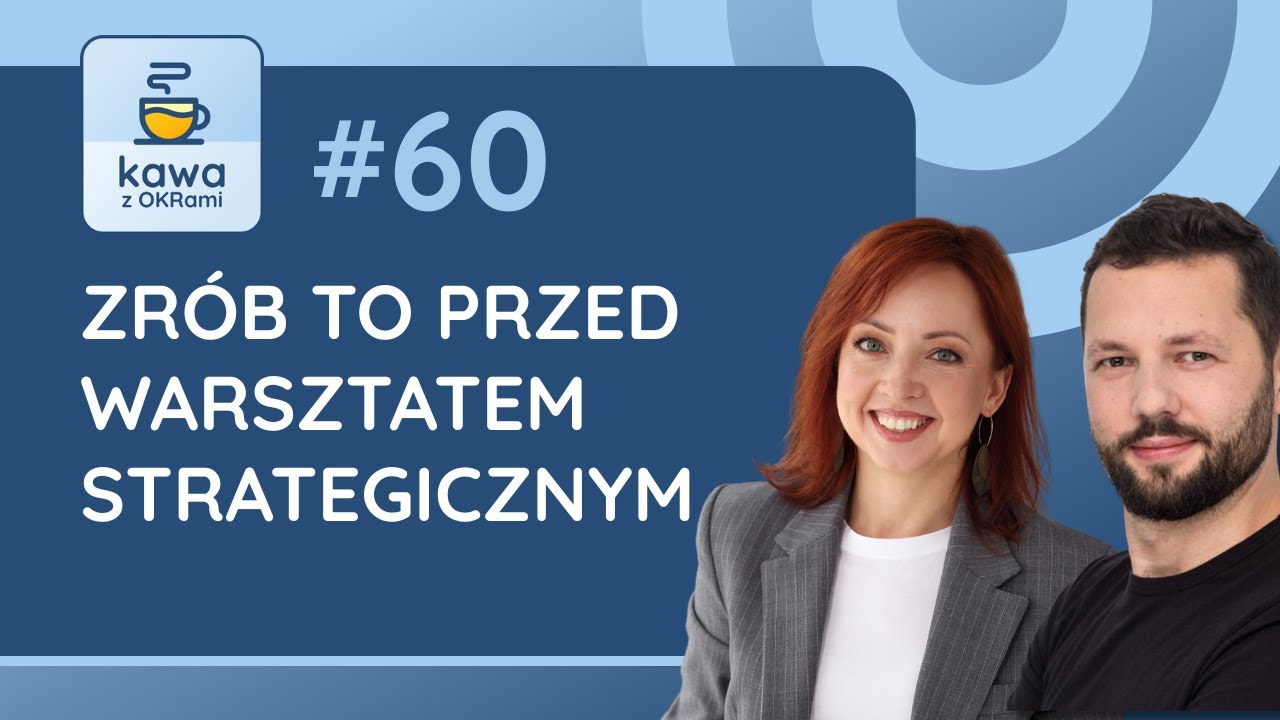 The recording is being edited. Leave your address and you'll get the link when it's ready.
We start work on strategy with a list of questions sent to the client before anyone walks into the room. The reason is unromantic: a strategy workshop is a place for decisions, and you can't make decisions at the same time as you gather data. When the hours you have set aside go on establishing who our clients are and who our competitors are, everyone leaves feeling their time was wasted, and they are right.
There are seven blocks and the order is not accidental. Foundations: mission, vision, values, where we write the values down twice, the ones the company already has and the aspirational ones, and for each we add the behaviours that show you it is really being lived. The scope of the strategy and the company profile: what period we are writing it for, realistically two to three years at today's pace of change, which markets we are in today and which we want to be in at the end of that period. A diagnosis of current problems together with the assumptions we are making, meaning what has to stay true for the plan to make sense. Directions and the main strategic assumptions. Current initiatives and the project portfolio. Knowledge about the organisation: who is really responsible for the key areas, which critical skills are missing and how many people report to one person, because ten or more is a red flag. And the seventh block, lessons from previous periods: what worked in the last twelve months and why, what didn't work and why, what we learned from it.
Almost everything we ask about already exists in the company, just in a dozen or more places at once. You will get the client and market profile from sales reports and from the CRM. What the company really considers important today shows in the KPIs that the bonuses of the board and managers depend on. The value proposition sits in brochures and product presentations, the personas in marketing materials, and the challenges and risks in notes from board meetings, in previous attempts at writing a strategy and in the risk register, if anyone keeps one. A company that already works in a cycle of retrospectives gathers the lessons from the whole year in about five minutes. A company without that cycle still has to collect them, and that too tells you something about it.
The most important thing, though, is what you can't see on this list. The product of this work is not a folder of materials but a shared understanding of the current state within the board. Usually every person at the table has a different view of the clients, the competition and the challenges, and until that is aligned the strategic conversation goes nowhere. That is why we don't bring two hundred pages of report with a ready-made picture of the client's world and tell them this is what their market looks like. We ask what it looks like, because a strategy should be the board's vision supplemented by observations from outside, not the other way round. The list itself grew out of a slip of ours: we used to share the strategy OnePager and kept hearing that it was hard to fill in alone. It turned out to be a great tool for us, not for clients, because we know what belongs in each box. Working with questions is much easier than working with an empty box labelled strategic goals.
Takeaways
Four things worth settling before the first meeting
- 01
A mission is not a slogan for the wall
The question is: why this business in particular, when money can be made in many other ways, for example by selling the company or hiring a board to run it. If you don't have this written down, let each member of the board write down separately, on a sheet of paper, their own motivation: why they get up in the morning and come here of all places.
- 02
An unwritten vision blocks very concrete decisions
Two partners had been unable for a long time to decide whether to launch one of their products. When we probed, it turned out they had two different, never written down visions of the company. Without that discovery they would have looked for the cause a level lower, in people not delivering on goals or delivering the wrong ones.
- 03
Naming the competition is not enough
You know who they are and how big they are, and that is where the analysis ends. Go down to the level where you can say what you beat them with, what you lose to them on and how often you actually meet them in the sales process.
- 04
Strategic in a project name means nothing
Projects are sometimes called strategic so that they get priority, while their link to the strategy is secondary. When you review the portfolio, check it the other way round: does this project really push the organisation in the direction you have chosen.
The whole topic in one place
How we work with clients when shaping strategy and operations
This list is only the way in. After it come the decisions, a one-page strategy, hypotheses and goals, and finally a weekly rhythm of working with the numbers. We have described that whole path, from an empty room to a company that looks at its metrics every week, in a single text. You will also find there every episode in which we take the individual stages apart one by one.
Author


Lena Zhukova
founder; strategy workshops, quarterly sessions
Founder of OKR Poland. For twenty years she has worked with boards of companies from 30 to a few thousand people; she wrote dozens of strategies with them and helped implement them in more than 40 organisations.
Next texts by e-mail
The OKR Poland newsletter
We write when we have something to say. To start: eight hours of recording on preparing a company for strategy workshops, plus the OnePager.