Coffee with OKRs #33 · 6 min read
Complaining there's no time for goals isn't a flaw in the method. It comes from two skipped exercises
Three quarterly objectives, each with people assigned from the board, production, marketing and customer service. Add it up and you see that two people sit in all three objectives at once. Status meetings alone take an hour and a half of their week before anyone starts doing anything.
From the episode · in Polish
Two exercises worked through on concrete examples
In the recording we go through a breakdown of three objectives with the people assigned to them and show where the overload becomes visible and what a decision to move someone into a consulted role looks like. There is also a practical part on how to do the same exercise with tools, in a table or on a board with sticky notes, and a description of the layers of meetings that overlap in companies so much that the flow of information gets skewed. The workload exercise starts in the first part of the conversation. from 00:09:04
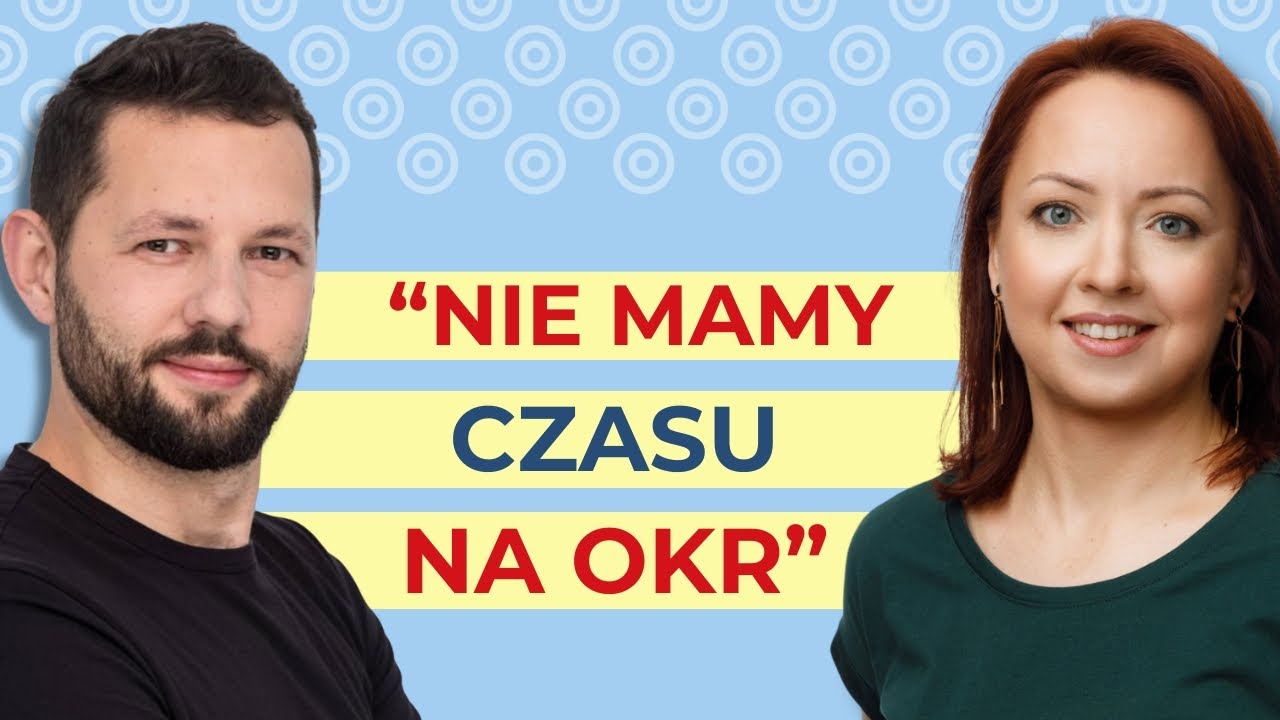 The recording is being edited. Leave your address and you'll get the link when it's ready.
Writing annual and quarterly goals looks like the finale, because it is usually preceded by a lot of debate. In our experience it is only the start, and this is exactly the hardest moment. Most organisations stop at assigning people to objectives and set off into the quarter. The first exercise is something simpler: write down who is in which objective and mark the people who appear in several places. In a large company, seven quarterly objectives look harmless on paper until it turns out they have been staffed with practically the same people. Then separate the roles. On one side the people who actually work on the objective and attend the weekly meetings, on the other those we only consult because we need a decision, support or an opinion from them. That takes away from the bottlenecks the duty of sitting in on everything. The aim is for people to spend their time on valuable work, not in meetings.
This exercise is not about setting a percentage of workload per person, along the lines of thirty per cent here and twenty there, because that simply doesn't work. The point is to check whether we are pushing someone into too many priorities at once. The outcome is one of five decisions: fewer objectives, replacing someone with another person and bringing them up to speed, outside support, recruitment, or moving the objective to the next quarter. You do it before the quarter starts, not halfway through, because people tend to overestimate their own capacity in the short term. There is one more benefit we rarely look at from this angle. A person who appears in every objective is a sign that the organisation is breeding indispensable people. A planned stand-in and bringing someone else up to speed build competence in a place that used to be a bottleneck.
The second exercise is a meeting audit, so that the meeting about goals doesn't become yet another meeting added to the list. Write down what meetings the company already has, what they are for, what participants are supposed to do in them and what result they should leave with. You need two levels: OKR owners, where decisions are made about shifting resources or stopping work on an objective, and working teams, where you settle whether the current initiative will lead to the key result. The cadence has to follow the rhythm of the teams' work, not the other way round. A weekly meeting in a team that ships a product every two weeks, or produces in a three-week cycle, has nothing to fill it and is seen as something that wrecks the current way of working. Even the order within the week matters, because a goals meeting on Monday and an operational one on Wednesday pull apart the moment decisions are made, and people either repeat the same information or hold it back.
Takeaways
Four things to do before the quarter starts
- 01
Count people, not objectives
Three objectives at the organisation level is already a lot, and sometimes there are twelve or fifteen. But the number of objectives tells you nothing until you put names against them and see who sits in how many of them at once.
- 02
Separate the people who work from those who are consulted
One person taking part in all three objective teams means half an hour per meeting and an hour and a half a week on status updates alone. Some of these people don't need to be there every week, it is enough to ask them for a decision.
- 03
Five decisions instead of percentages
Fewer objectives, replacing a person and bringing in a successor, outside support, recruitment, or moving the objective to the next quarter. Setting a fixed percentage of time for goals per person doesn't work and only blurs the picture.
- 04
Cadence follows the team's rhythm
Two parallel cadences, one for the company's work and another invented for the method, guarantee the feeling that goals run alongside the organisation. Match the frequency and order of meetings to the cycle in which the team actually works.
The whole topic in one place
Why doesn't the team deliver on its goals? Looking for the cause
People's workload and the calendar are two of the reasons a quarter stalls, and both concern what happens around the objective. That leaves the objective itself, that is, whether anyone has agreed on it and how we will know it has been achieved. You will find the full list of reasons, together with all the episodes in which we talked about them, under the button alongside.
Author


Lena Zhukova
founder; strategy workshops, quarterly sessions
Founder of OKR Poland. For twenty years she has worked with boards of companies from 30 to a few thousand people; she wrote dozens of strategies with them and helped implement them in more than 40 organisations.
Next texts by e-mail
The OKR Poland newsletter
We write when we have something to say. To start: eight hours of recording on preparing a company for strategy workshops, plus the OnePager.